☎ 1800 202 2912 | +91 9717773968 | info@inventanteducation.com

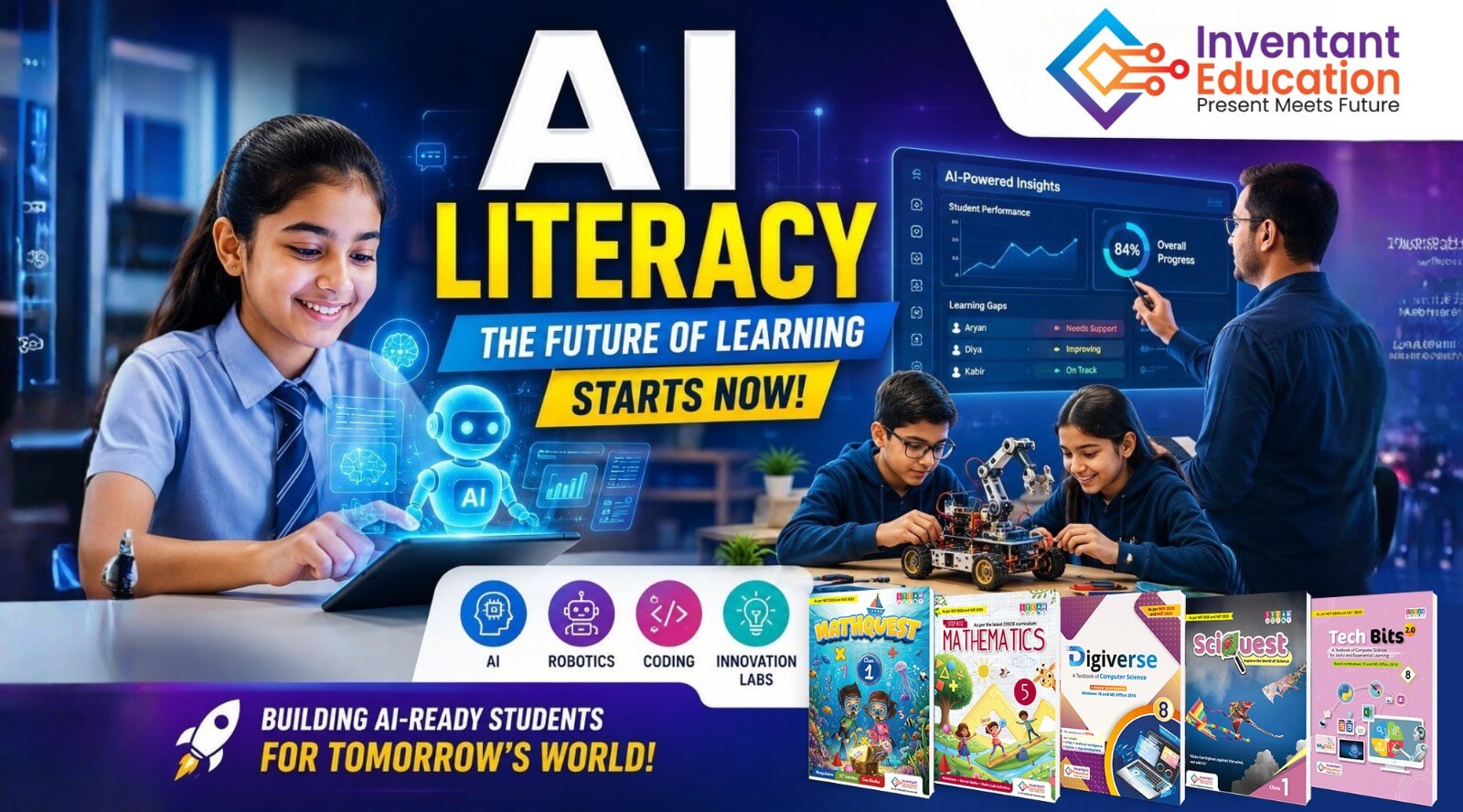
AI Literacy in Indian Classrooms: Why 2026 Is the Year Everything Changes

India, STEM education India, AI textbooks India
Introduction: The Classroom Is No Longer Just a Room
Picture a Class 9 student in Noida opening her textbook — not just to read, but to interact with an AI model embedded in her learning app. A teacher in Chennai using intelligent assessment tools that tell him exactly which student is struggling with algebra and why. A principal in Pune integrating robotics and machine learning projects into her school’s science week.
This is not the future. This is India’s education landscape in 2026.
Artificial Intelligence has quietly — and then very loudly — walked into the Indian classroom. And unlike previous tech trends that remained confined to a few elite institutions, AI literacy in 2026 is rapidly going mainstream across all disciplines, all boards, and all age groups.
What Is AI Literacy — and Why Does It Matter?
AI literacy does not mean turning every student into a coder or data scientist. It means equipping learners to understand, use, evaluate, and work alongside AI tools in everyday academic and professional settings.
Think of it the way we once thought of computer literacy in the 1990s. Back then, knowing how to use a computer was a specialised skill. Today, it is a baseline expectation. In the same way, AI literacy is rapidly becoming the new baseline — and Indian education is catching up fast.
According to the QS I-GAUGE AI Adoption Survey launched in June 2026, educators across India — from school teachers to university faculty — are being assessed on their perceptions of AI, their current usage, and their readiness to adopt it professionally. The fact that this survey spans all educational boards and institutional levels signals just how broad this shift has become.
The Government Has Put Its Money Where the Future Is
India’s commitment to AI in education is not just rhetorical. The Union Budget 2026–27 allocated ₹100 crore for a dedicated Centre of Excellence in AI for Education — aimed specifically at personalising learning, enhancing skills, and deepening AI integration across the country’s institutions.
This is a landmark moment. It signals that AI is no longer being treated as a peripheral subject or an elective for engineering students. It is being woven into the very fabric of how India intends to educate its next generation.
Combined with the National Education Policy (NEP) 2020’s push for multidisciplinary and flexible learning, the stage is set for a structural overhaul — not just a cosmetic one.
From Engineering Labs to Every Classroom
One of the most dramatic aspects of India’s AI education shift in 2026 is the crossing of disciplinary boundaries.
Traditionally, AI and computer science were treated as the exclusive domain of Class 11–12 science students or undergraduate engineering programmes. That siloing is breaking down. Today, AI concepts are being introduced as early as Class 1 — through storytelling, games, and problem-solving activities that build computational thinking without a single line of code.
By middle school, students are exploring machine learning concepts, data patterns, and basic robotics. By high school, they are working with actual AI tools, building projects, and understanding the ethical dimensions of automation.
This is exactly the shift that Inventant Education — India’s first STEAM-focused publisher — has been building toward.
How Inventant Education Is Powering This Shift
At the heart of India’s AI literacy movement is the need for quality learning resources that make complex concepts accessible, engaging, and curriculum-aligned. This is where Inventant Education, a unit of Edulabz International and a sister concern of Goyal Brothers Prakashan, has emerged as a critical enabler.
Inventant’s portfolio directly addresses the growing demand for AI and technology education:
📘 A Concise Course in Artificial Intelligence (Subject Code 417)
Designed for CBSE students in Classes 9 and 10, this textbook — now in a revised edition — takes students on a human-centred journey through the world of AI. From understanding how machines learn to exploring real-world applications, it demystifies AI without overwhelming learners. It is one of the most widely used AI textbooks for school students in India today.
💻 Tech Infinity & Tech Trails 2.0
Inventant’s flagship computer science series for CBSE schools, these books go beyond syntax and theory. They integrate computational thinking, interactive coding, and technology innovation in a way that prepares students for an AI-driven world — not just an exam.
🤖 AI & Robotics Innovation Labs (Edulabz)
Perhaps the most forward-thinking offering from the Inventant ecosystem is its AI & Robotics Innovation Labs — cutting-edge educational facilities that nurture the next generation of problem-solvers. Designed for students aged 7 and above, these labs use real-world, application-based DIY projects to make AI and robotics tangible, exciting, and genuinely educational. Kids don’t just read about machine learning — they build with it.
📱 Edu Invent App
Inventant’s digital learning platform brings e-books, video lectures, animated lessons, practice exercises, and self-assessments under one roof — making AI and STEM learning accessible beyond the physical classroom. For teachers, the platform even includes a test paper generator, bridging the gap between content delivery and assessment.
Explore Inventant Education’s full range of AI, Computer Science, and STEM books:
👉 www.inventanteducation.com
📞 1800 202 2912 | +91 9717773968
Why Schools Cannot Afford to Wait
The India edtech market is already valued at $7.5 billion and is projected to grow nearly fourfold by 2030. Private investment is surging. AI-backed platforms are generating real-time, granular data on student learning trajectories — fundamentally changing how teachers teach and how parents engage with their child’s progress.
Schools that delay integrating AI literacy into their curriculum risk a growing gap — not just in academic outcomes, but in student confidence and career readiness.
Here is what the data and ground reality together tell us:
- Students who learn AI early develop stronger problem-solving, logical thinking, and adaptability skills.
- Teachers who use AI tools can personalise instruction, reduce administrative load, and identify learning gaps faster.
- Schools that invest in AI infrastructure — labs, digital content, trained faculty — are increasingly preferred by parents who understand the demands of tomorrow’s job market.
What Should Schools and Educators Do Right Now?
If you are a school leader, teacher, or parent navigating this shift, here is a practical starting point:
1. Audit your current curriculum — Does your school’s computer science or STEM programme include dedicated AI and machine learning modules? If not, it is time to add them.
2. Choose the right textbooks — Curriculum-aligned, board-approved, and pedagogically sound resources matter enormously. Inventant Education’s CBSE and ICSE titles are designed with exactly this in mind.
3. Move beyond theory — Books are the foundation, but hands-on experience is what cements learning. Look into Inventant’s AI & Robotics Innovation Labs for your school.
4. Upskill your faculty — The QS I-GAUGE survey underscores that teacher readiness is the critical bottleneck. Invest in professional development programmes that help educators not just use AI tools, but teach with and about them confidently.
5. Go digital — Tools like the Edu Invent App ensure that learning extends beyond school hours, giving students access to quality AI content anytime, anywhere.
The Bottom Line: AI Literacy Is Not Optional Anymore
India is at a defining crossroads in education. The government has committed resources, the policy framework (NEP 2020) is in place, and publishers like Inventant Education are delivering the curriculum tools needed to make AI literacy a reality — not just an aspiration.
The question for every school, every teacher, and every parent is no longer whether AI belongs in the classroom. It is how quickly and how well we can bring it there.
The students who graduate as AI-literate thinkers will not just be better prepared for jobs that exist today. They will be the ones who create the jobs of tomorrow.
About Inventant Education
Inventant Education is India’s first STEAM-focused publisher, a unit of Edulabz International and a sister concern of Goyal Brothers Prakashan. Committed to NEP 2020 alignment and practical STEM learning, Inventant offers textbooks, digital resources, and innovation labs for students from Class 1 to Class 12 across CBSE, ICSE, and State Boards.