☎ 1800 202 2912 | +91 9717773968 | info@inventanteducation.com

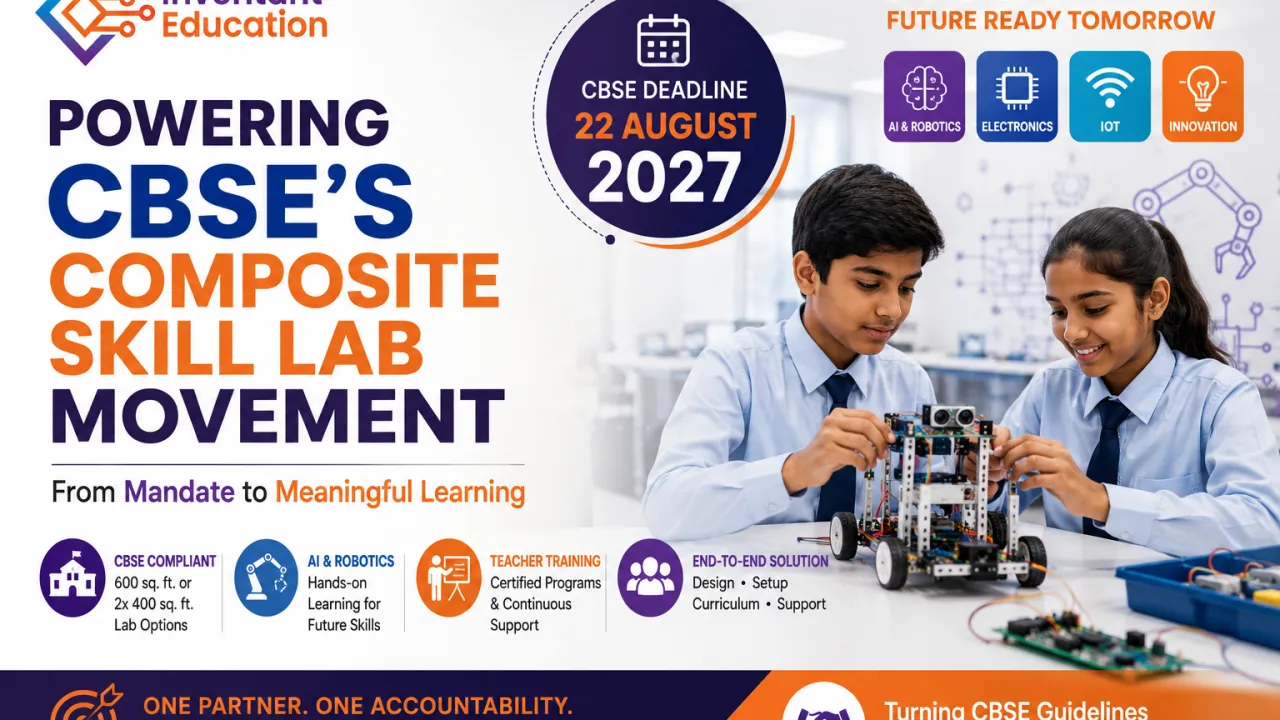
CBSE Composite Skill Lab: Requirements, Guidelines & 2027 Deadline

Every CBSE-affiliated school in India is now working against the same clock: 22 August 2027, the deadline by which a fully functional Composite Skill Lab must be in place. Schools applying for fresh CBSE affiliation don’t even get that runway — a compliant lab is required as part of the affiliation process itself.
For most school leaders, the challenge was never understanding that this is required. It’s figuring out how to turn a CBSE circular into a room where students are actually building, testing, and learning.
This guide walks through what a Composite Skill Lab is, what CBSE actually requires, how to plan implementation, and where a partner like Inventant Education fits into getting a school from “compliant on paper” to a lab that’s genuinely part of the academic year.
What Is a CBSE Composite Skill Lab?
A Composite Skill Lab (CSL) is a flexible, multi-sector space designed to give students hands-on exposure to skill and vocational education — not as an occasional activity, but as a structured part of the curriculum.
CBSE’s guidelines envisage a lab capable of supporting learning across sectors such as electronics, healthcare, agriculture, apparel, food production, IT/ITeS, artificial intelligence, and media and entertainment, among others relevant to a school’s local context. The underlying philosophy is learning by doing: students don’t just read about a sensor, they wire one; they don’t just study a business process, they run one.
Framed this way, a Composite Skill Lab isn’t another infrastructure line item. It’s a space where students can:
- Build and test physical projects
- Work directly with tools and equipment
- Explore emerging technology, including AI and robotics
- Solve real-world, open-ended problems
- Develop practical, employable skills
- Connect classroom theory to hands-on application
The Deadline and the Space Requirements
CBSE Circular No. 13/2026 confirms that already-affiliated schools have three years from the original circular date to establish their lab, which puts the deadline at 22 August 2027. Schools seeking fresh CBSE affiliation must already have the required lab infrastructure in place.
On space, schools have two configuration options:
Option 1 — One combined lab: Approximately 600 sq. ft., serving Classes VI–XII.
Option 2 — Two separate labs: Approximately 400 sq. ft. each one for Classes VI–X, one for Classes XI–XII.
CBSE has also clarified that its equipment lists are suggestive rather than fixed, meaning schools can adapt the tool mix to their own readiness, budget, and local context. That flexibility is useful, but it also means the real planning question isn’t just “where do we put the lab?” — it’s “what kind of learning experience should this space actually enable?”
What Setting Up a Composite Skill Lab Actually Involves
A functional CSL requires considerably more than a procurement order. CBSE’s guidelines cover infrastructure planning, sector-specific tools and equipment, safety protocols, AI integration, and how to make efficient use of existing school space. In practice, implementation breaks down into five stages:
1. Space assessment and planning
Understanding the school’s available floor area, likely student capacity, workstation layout, storage needs, electrical load, technology infrastructure, safety arrangements, and how students will move between sector-wise activity zones.
2. Lab design and infrastructure
Workstations, furniture, tools, storage, technology, and safety systems designed to work together not purchased as unrelated line items that happen to share a room.
3. Tools and equipment
A sector mix matched to the age groups using the lab, with realistic planning for consumables, maintenance, and replacement cycles — not just the initial purchase.
4. Curriculum and learning resources
Equipment alone doesn’t teach skill education. Students need structured projects, lesson plans, and activity sequences that give teachers a clear path from “we have the tools” to “students are learning with them.”
5. Teacher training
Teachers and lab in-charges need to understand not just how equipment works, but how to run practical sessions safely, manage a hands-on classroom, and connect activities back to curriculum objectives.
Why AI and Robotics Are Central, Not Optional
One of the more significant details in CBSE’s Composite Skill Lab guidelines is the explicit inclusion of Artificial Intelligence integration alongside traditional skill sectors. This isn’t a “nice to have” bolted onto the framework — it’s part of the core design.
For schools, this is an opening to teach AI, robotics, electronics, coding, and IoT through hands-on projects rather than slideshows. Instead of learning about automation in the abstract, a student can build a working sensor-based system, test it, watch it fail, and fix it — which is a fundamentally different (and stickier) kind of learning than a textbook diagram. It’s also directly relevant as schools work to align with NEP 2020 and NCF-SE 2023, both of which treat future-ready, applied skills as core outcomes rather than electives.
How Inventant Education Supports CBSE Schools
This is where Inventant Education’s role in the Composite Skill Lab movement comes in. Inventant approaches implementation as an end-to-end education solution — infrastructure, curriculum, technology, and people together — rather than an equipment-supply exercise.
AI & Robotics Innovation Labs
Inventant’s AI and Robotics Labs give schools a dedicated environment for hands-on learning across robotics, coding, electronics, AI, and IoT, built to take students from concept to working project rather than concept to worksheet.
Project-based robotics and electronics kits
Younger learners in particular benefit from tangible outcomes. Inventant’s Grade 6 Smart City Robotics Kit is built around five real activities — a smart pedestrian crossing, smart street lighting, a smart traffic light, a security alarm, and an emergency alert system — so students see, concretely, how sensors, wiring, and logic combine to solve a real-world problem.
Digital learning that extends past the lab period
A physical lab doesn’t have to be the only place learning happens. The Edu Invent App lets students continue project work at their own pace outside scheduled lab sessions, and Inventant’s broader coding and AI platforms give schools structured digital resources to pair with hands-on equipment.
Curriculum built for progression, not just activities
Inventant’s curriculum — including content mapped to CBSE’s AI Curriculum under Subject Code 417 — is designed so projects get more complex as students move up through grades, rather than repeating the same activity at every level.
Teacher training and an ongoing support network
Training is built into the offering, not sold separately — covering equipment operation, safe practical sessions, classroom management during hands-on activities, and how to tie projects back to assessment. Inventant also connects participating schools to the Educators Guild of India, giving teachers access to a wider community of skill-education practitioners and continued professional development after the initial rollout.
From Compliance to Classroom Culture
The question school leaders should be asking isn’t “how do we complete our CBSE Composite Skill Lab requirement?” It’s “how do we build a lab that students and teachers will actually use?”
That distinction matters more than it sounds. A room full of equipment can satisfy an infrastructure checklist without ever becoming part of how the school actually teaches. A successful Composite Skill Lab is different: students use it regularly, teachers are confident running sessions in it, projects connect to what’s being assessed, equipment gets maintained rather than gathering dust, and learning outcomes are visible — not just implied.
The goal isn’t a compliant laboratory. It’s a working skill-learning environment.
Ten Questions Schools Should Answer Before Building
Starting early gives school leadership room to think through decisions properly instead of making them under deadline pressure. Before finalising a Composite Skill Lab plan, schools should have clear answers to:
- Space — Where will the lab be located, and does it fit the 600 sq. ft. / 400 sq. ft. requirement?
- Capacity — How many students will use it at any one time?
- Sectors — Which skill sectors are most relevant to this school’s students and local context?
- Infrastructure — What electrical, furniture, and technology work is needed?
- Equipment — What tools and kits does the chosen sector mix require?
- Curriculum — What will students actually be learning, session by session?
- Teachers — Who will run the practical sessions?
- Training — What professional development do those teachers need first?
- Maintenance — How will equipment, consumables, and replacements be managed long-term?
- Timeline — How quickly can the lab realistically become operational?
Choosing a Composite Skill Lab Partner
Schools evaluating vendors should look past the equipment catalogue and ask a sharper set of questions:
- Does the provider actually understand CBSE’s Composite Skill Lab guidelines, or just skill-lab equipment in general?
- Can they assess and plan the school’s specific available space?
- Do they provide curriculum alongside infrastructure, or leave that to the school?
- Is teacher training included, or a separate cost?
- Are AI and robotics capabilities genuinely built in, or added on as an afterthought?
- Who handles installation and implementation, start to finish?
- What support exists after handover? Is there anyone to call when something breaks?
- Can the solution flex around the school’s existing infrastructure, or does it assume a blank room?
The right partner connects infrastructure, curriculum, technology, and people as one package not four separate vendor relationships a school has to manage itself.
The Road to 2027
The Composite Skill Lab mandate is bigger than an infrastructure deadline. It’s part of a broader shift toward experiential, skill-based learning in Indian schools — one where CBSE’s own framework describes the goal as a student-centred environment where learners discover the purpose of what they’re learning through direct experience, not just exam preparation.
Used well, a Composite Skill Lab becomes the place where a student builds their first working robot, understands how a sensor actually behaves, prototypes a solution to a real problem, and starts discovering skills they may carry into higher education or a career. That’s the difference between setting up a lab and building a genuine culture of skill education.
Schools planning their Composite Skill Lab can connect with Inventant Education for a consultation, site assessment, and implementation proposal.
Frequently Asked Questions
What is a CBSE Composite Skill Lab? A flexible, multi-sector learning space that gives students hands-on exposure to skill and vocational education, covering sectors such as electronics, healthcare, agriculture, IT/ITeS, artificial intelligence, and media and entertainment.
What is the CBSE Composite Skill Lab deadline? Already-affiliated CBSE schools must have a functional lab in place by 22 August 2027, per CBSE Circular No. 13/2026. Schools seeking fresh affiliation must meet the requirement immediately, as part of the affiliation process.
How much space does a Composite Skill Lab need? Either one 600 sq. ft. lab for Classes VI–XII, or two 400 sq. ft. labs: one for Classes VI–X, one for Classes XI–XII.
Is AI part of the Composite Skill Lab requirement? Yes. CBSE’s guidelines explicitly include AI integration and list artificial intelligence among the emerging skill areas schools can build into their labs.
Do schools need teacher training for the lab to count as compliant? Teacher readiness isn’t formally optional in any meaningful sense; a lab without trained staff won’t function as intended. Schools should ensure teachers and lab in-charges understand equipment operation, safety protocols, and how to run practical sessions before the lab goes live.
Can robotics be part of a Composite Skill Lab? Yes, robotics, AI, coding, electronics, and IoT all fall within the technology and emerging-skills component of the framework, and are commonly delivered through project-based kits.
Should schools wait until closer to 2027 to start? No. Space assessment, procurement, curriculum planning, and teacher training all take coordination and lead time. Starting early lets a school build a lab that becomes an active part of its academic programme, rather than a last-minute compliance exercise finished under pressure.
How does a school get started? Begin with an honest assessment of available space, existing infrastructure, student numbers, likely skill sectors, and teacher readiness. From there, a Composite Skill Lab implementation plan — covering design, equipment, curriculum, training, and ongoing support — can be built around the school’s specific context.
Sources: CBSE Circular No. Skill-75/2024; CBSE Circular No. 13/2026; CBSE Guidelines for Setting up Composite Skill Lab in Schools; NEP 2020; NCF-SE 2023.