☎ 1800 202 2912 | +91 9717773968 | info@inventanteducation.com

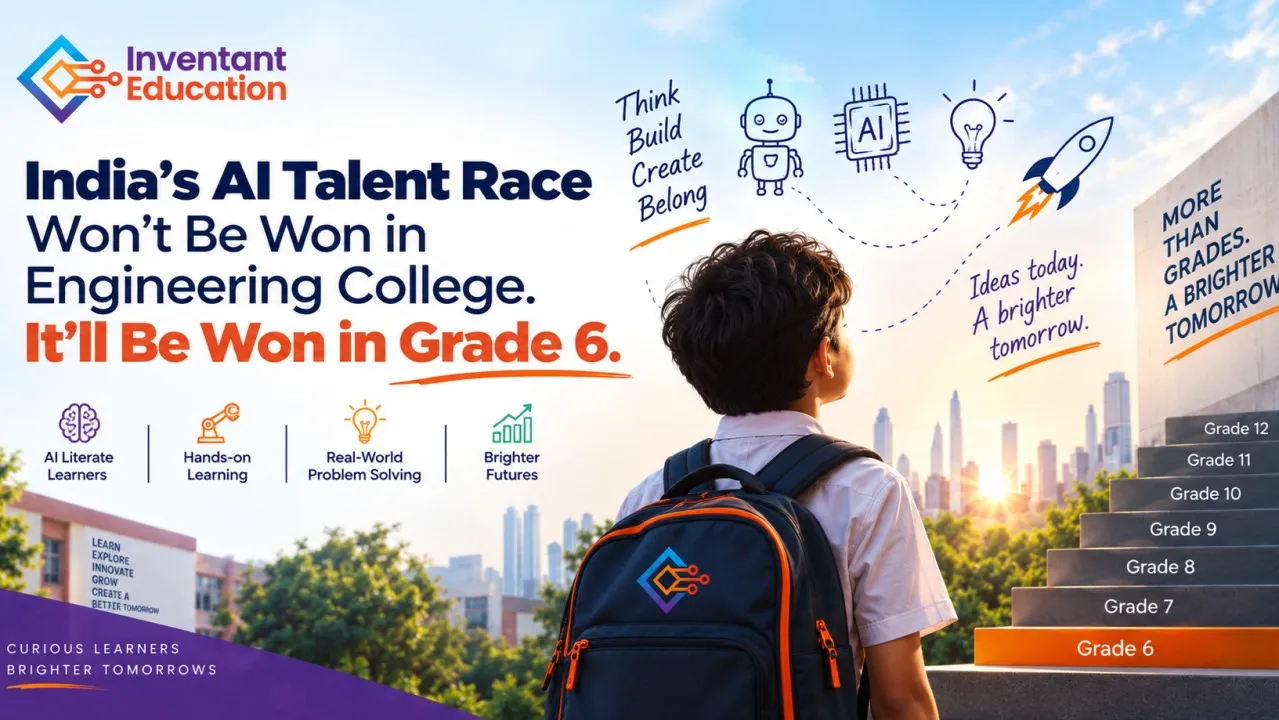
India’s AI Talent Race Won’t Be Won in Engineering College. It’ll Be Won in Grade 6.

Here’s a number worth sitting with: India already commands 16% of the world’s AI talent pool, a share projected to swell to 1.25 million professionals by 2027.
That’s a genuine head start in the global AI economy. Here’s the number sitting right beside it that should give every school leader pause: national graduate employability, even after years of reform, has only just crossed 56%. Nearly 44% of India’s youth still fall short of industry job-readiness standards. Set those two numbers side by side, and the story writes itself. India isn’t short on ambition. It isn’t short on talent. And it certainly isn’t short on opportunity.
What it’s short on is runway the years of hands-on, applied skill-building that turn raw talent into confident, capable professionals. And that runway has to begin long before college.
The Skills Employers Want Are Shifting Fast
The workplace is already transforming beneath our feet. AI and machine learning now rank among the capabilities professionals most often flag as critical for the next 3–5 years. Generative AI is no longer something students discover after graduation — it’s already woven into how people research, create, analyse, communicate and solve problems at work.
That shifts the question schools need to be asking. It’s no longer:
“Should our students learn AI?”
It’s: “How early should they start learning to think with technology?”Because knowing how to operate an AI tool is only the surface layer of AI literacy.The real advantage lies deeper — in learning how to break problems apart, spot patterns, prototype solutions, experiment, fail, iterate, and wield technology responsibly. None of that is built overnight.
Why Waiting for College Is Too Late
For years, Indian education has treated “skills” as something bolted on late — an elective, a certification, a coding boot camp squeezed into final-year placement prep.
But technology isn’t waiting for the curriculum to catch up. A student who first meets robotics, computational thinking, or AI in a college classroom is learning tools. A student who has spent Grades 6–12 building projects, wiring sensors, writing code, working alongside AI, and wrestling with real-world problems is developing something far more valuable: a way of thinking. That gap compounds, year over year. By the time both reach college, one is still learning to use the technology while the other is already asking:
“What can I build with it?”
That’s the shift schools now have the chance to create.
From Learning About Technology to Building With It
This is precisely the gap Inventant Education was built to close in the K–12 ecosystem. The goal was never to drop a robotics kit in a classroom and call it innovation, or bolt “AI” onto a syllabus as a buzzword. It’s to build an ecosystem where students progress deliberately — from understanding technology, to experimenting with it, to building with it, to solving real problems through it. Through age-appropriate AI and robotics programmes, hands-on STEM/STEAM learning, computational thinking and project-based activities, Inventant Education helps schools weave this approach into everyday learning — not as an add-on, but as a habit of mind.
Every programme is designed to bridge classroom concepts with practical application, giving students room to build, break, troubleshoot and create rather than passively consume technology. For schools ready to integrate AI systematically, Inventant also supports CBSE-aligned AI learning, including Subject Code 417, backed by teacher capacity-building — so the capability takes root inside the school, not just inside a vendor contract.
Because the goal was never to make schools dependent on an outside programme.
The goal is to build the capability in-house.
The Real Opportunity for Schools
India’s employability numbers have climbed meaningfully in recent years. That’s real progress worth celebrating. But the bar keeps rising too. Tomorrow’s employers won’t simply ask whether a candidate holds a degree. They’ll ask:
Can they think critically?
Can they work alongside AI?
Can they solve problems they’ve never seen before?
Can they build, test, and iterate?
Can they adapt as the technology itself keeps changing?
None of that gets built overnight in a placement season. It’s built through years of deliberate practice. Which is exactly why the conversation around AI education needs to outgrow “AI courses for students.”It needs to become a conversation about long-term AI readiness. Schools that start this journey in Grade 6 — giving students years of exposure to robotics, computational thinking, AI, coding, and real-world problem-solving — aren’t offering enrichment.
They’re laying the employability foundation for the next generation.
The AI talent race won’t be decided in final-year placement season. It’s already being decided in classrooms today. And schools that start early aren’t just preparing students for the future.
They’re giving them a head start in building it.