☎ 1800 202 2912 | +91 9717773968 | info@inventanteducation.com

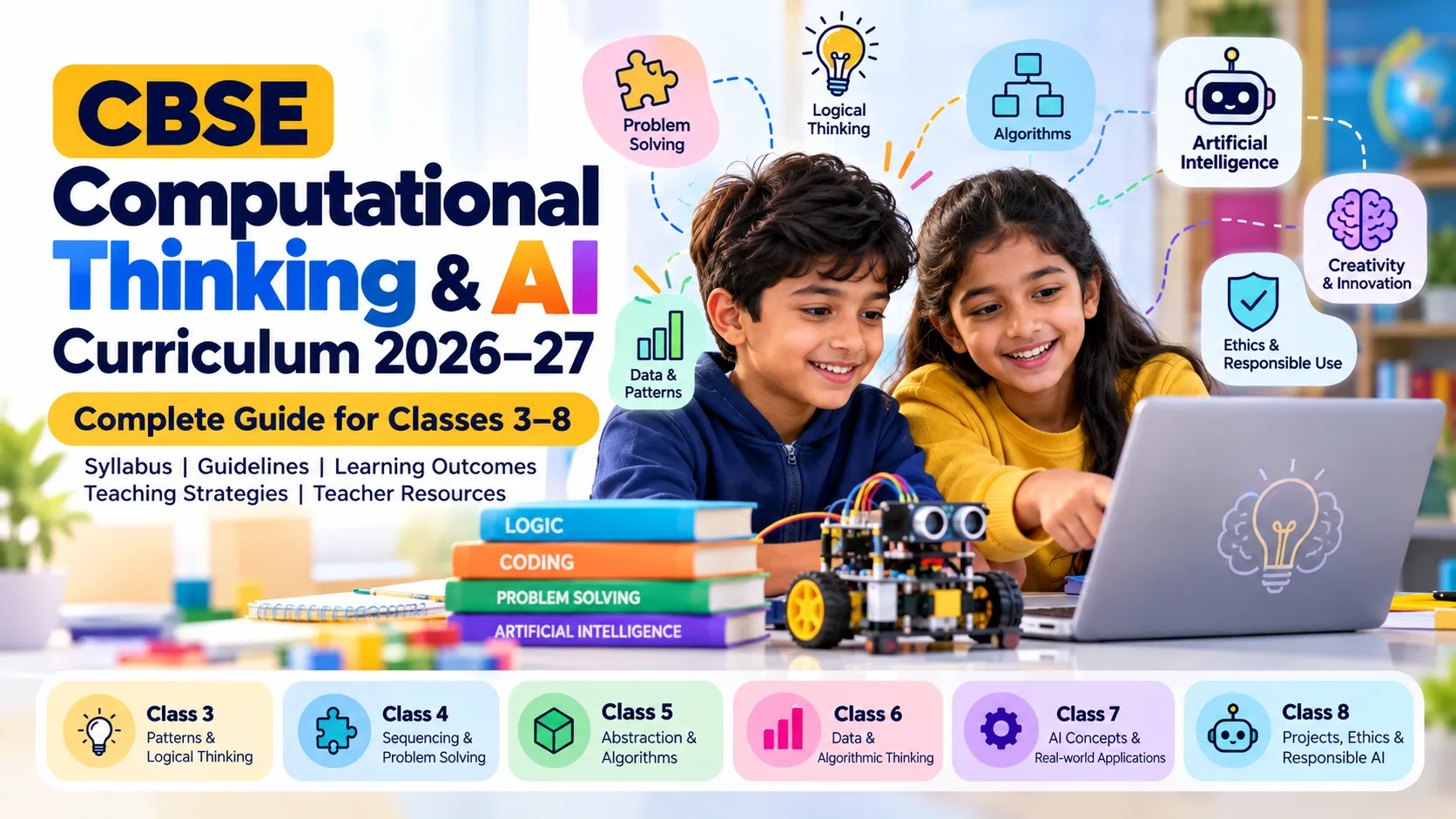
CBSE Computational Thinking and AI Curriculum 2026–27: Complete Guide for Classes 3–8

Computational Thinking and Artificial Intelligence are becoming important parts of school education in India. As students increasingly interact with digital technologies, schools need to help them develop the ability to think logically, solve problems systematically, recognise patterns, and understand how intelligent technologies work.
To support this direction, the Central Board of Secondary Education (CBSE) introduced the Computational Thinking (CT) and Artificial Intelligence (AI) Curriculum for Classes III–VIII from the academic session 2026–27. The curriculum is aligned with the National Education Policy (NEP) 2020 and the National Curriculum Framework for School Education (NCF-SE) 2023.
The framework focuses on developing foundational computational thinking skills, introducing age-appropriate AI concepts, encouraging interdisciplinary learning, and promoting the responsible use of technology.
For schools, principals, academic coordinators, and teachers, understanding this curriculum is essential for planning classroom activities, selecting appropriate learning resources, and preparing students for a technology-driven future.
In this guide, Inventant Education explains the meaning of computational thinking, the CBSE CT and AI curriculum for Classes 3–8, grade-wise learning priorities, implementation guidelines, teaching approaches, assessment methods, and practical ways schools can strengthen computational thinking and AI education.
What Is Computational Thinking?
Computational Thinking is a structured approach to solving problems by breaking them into manageable parts, identifying patterns, focusing on relevant information, and developing step-by-step solutions.
It does not mean that students must always use computers. Computational thinking can be developed through puzzles, mathematics problems, classroom discussions, games, diagrams, physical activities, and everyday situations.
For example, when students plan the most efficient route from home to school, identify a pattern in a number sequence, or arrange instructions in the correct order, they are practising computational thinking.
Four important concepts are:
- Decomposition: Breaking a complex problem into smaller, manageable tasks.
- Pattern recognition: Identifying similarities, repetitions, and relationships.
- Abstraction: Focusing on important information while ignoring unnecessary details.
- Algorithmic thinking: Designing a clear sequence of steps to solve a problem.
These skills help students approach unfamiliar challenges logically and develop solutions that can be explained, tested, and improved.
What Is Artificial Intelligence in School Education?
Artificial Intelligence is a field of technology that enables computer systems to perform tasks associated with human intelligence, including recognising patterns, analysing data, understanding language, and making predictions.
AI education helps students understand not only how these technologies are used but also how they work, where they can fail, and why they must be used responsibly.
Students can explore AI through everyday examples such as voice assistants, image recognition, translation tools, recommendation systems, and data-based predictions.
At the school level, AI education should be age-appropriate, activity-based, and focused on conceptual understanding rather than advanced technical complexity.
Why Are Computational Thinking and AI Important in Schools?
Computational thinking develops foundational reasoning skills that students can apply across subjects. AI education builds on this foundation by helping students understand data-driven systems and emerging technologies.
Together, they support several important educational outcomes.
1. Logical Reasoning and Problem-Solving
Students learn to analyse a problem, identify the information they need, and organise a solution into clear steps. These skills are useful in mathematics, science, languages, and everyday decision-making.
2. Creativity and Innovation
Students can explore different ways to solve a problem, compare possible approaches, and develop original ideas. They learn that a problem may have more than one valid solution.
3. Interdisciplinary Learning
Computational thinking can be integrated into mathematics, environmental studies, language learning, science, and other subjects. Students can apply the same reasoning skills in different contexts.
4. AI Literacy
Students gradually learn what AI can do, how data influences its output, and why AI-generated answers should be evaluated critically.
5. Digital Responsibility and Ethics
Students develop awareness of privacy, fairness, bias, misinformation, data protection, and the responsible use of digital tools.
The aim is not simply to teach students how to operate technology. It is to help them become independent thinkers who can understand, question, evaluate, and use technology responsibly.
CBSE Computational Thinking and AI Curriculum 2026–27: An Overview
CBSE’s official curriculum framework covers Classes III–VIII and follows a progressive learning approach. The emphasis changes as students move from foundational reasoning activities to more structured computational thinking and AI concepts.
| Curriculum component | Classes 3–5 | Classes 6–8 |
|---|---|---|
| Primary focus | Foundational computational thinking | Advanced computational thinking and early AI |
| Learning approach | Integrated, activity-based learning | Structured learning and interdisciplinary projects |
| Common activities | Puzzles, patterns, visual reasoning and stepwise problems | Algorithms, data analysis, AI concepts and projects |
| AI learning | Building readiness through reasoning and digital awareness | More explicit exploration of AI, data and responsible use |
| Teaching support | Student and teacher resource books | Student and teacher resource books |
The official CBSE curriculum and supporting circulars provide the authoritative reference for schools implementing this programme.
Schools should consult the latest official documents for the prescribed syllabus, learning outcomes, resources, and implementation details.
Official reference: CBSE Computational Thinking and Artificial Intelligence
CBSE CT and AI Syllabus for Classes 3–5
For Classes 3–5, the curriculum emphasises foundational computational thinking integrated into regular classroom learning. The approach is designed to help children develop reasoning skills through familiar concepts, visual representations, puzzles, and structured problems.
CBSE’s resource books accompany the regular mathematics curriculum, with connections to The World Around Us (TWAU). They are intended to support classroom teaching rather than replace regular textbooks.
Computational Thinking in Class 3
At this stage, students begin developing foundational reasoning and problem-solving skills.
Learning activities can focus on:
- Identifying and extending simple patterns.
- Recognising shapes and basic visual relationships.
- Solving problems using clues and visual information.
- Arranging events or instructions in the correct order.
- Following and explaining simple step-by-step procedures.
Example activity: Students identify the rule in a sequence of shapes, predict the next shape, and explain their reasoning.
The learning goal is to encourage students to describe how they reached an answer rather than simply state the answer.
Computational Thinking in Class 4
Students gradually work with more complex patterns, relationships, and multi-step problems.
Learning activities can include:
- Recognising patterns involving more than one rule.
- Exploring symmetry, rotation, and reflection.
- Solving problems using multiple clues.
- Understanding conditions in step-by-step instructions.
- Organising information into tables, diagrams, and visual representations.
Example activity: Students follow a set of directional instructions to guide a character through a grid while identifying and correcting errors in the route.
This develops logical reasoning, sequencing, and the ability to check whether a solution works.
Computational Thinking in Class 5
Students progress towards more complex reasoning and interconnected problems.
Learning activities can include:
- Identifying relationships across multiple patterns.
- Solving problems involving several clues and constraints.
- Breaking larger problems into smaller tasks.
- Comparing different solution strategies.
- Developing and evaluating multi-step procedures.
Example activity: Students solve a classroom scheduling puzzle by arranging activities while following several conditions.
The focus is on developing systematic thinking and explaining the logic behind a solution.
CBSE CT and AI Curriculum for Classes 6–8
At the middle-school level, the curriculum expands beyond foundational reasoning to include more advanced computational thinking, introductory AI concepts, data-based decision-making, and ethical awareness.
Students begin connecting the processes used in computational thinking with the ways AI systems use data and models to produce outputs.
Computational Thinking and AI in Class 6
Class 6 introduces students to more structured problem-solving and foundational AI awareness.
Learning areas include:
- Decomposition and algorithmic problem-solving.
- Patterns, generalisation, and abstraction.
- Data representation and interpretation.
- Introduction to artificial intelligence and its everyday applications.
- Understanding how data supports decisions and predictions.
- Digital safety and responsible technology use.
Example activity: Students organise a small dataset into a table, identify a pattern, and explain how the pattern could help answer a question.
The goal is to connect logical reasoning with an introductory understanding of data and AI.
Computational Thinking and AI in Class 7
Class 7 builds on earlier learning by encouraging students to work with more complex problems, compare patterns, and explore AI applications.
Learning areas include:
- Developing and evaluating algorithms.
- Representing and interpreting data.
- Exploring AI applications in different fields.
- Understanding how AI systems use data to identify patterns.
- Investigating the limitations of AI-generated outputs.
- Discussing fairness, bias, and responsible technology use.
Example activity: Students compare two datasets and discuss how differences in the data could influence a prediction.
This helps students understand that data quality and the choice of information can affect an AI system’s output.
Computational Thinking and AI in Class 8
Class 8 encourages students to apply computational thinking more independently and evaluate the role of AI in solving problems.
Learning areas include:
- Designing stepwise solutions to multi-variable problems.
- Applying abstraction and generalisation.
- Analysing data and interpreting patterns.
- Exploring AI project planning and problem definition.
- Examining how AI systems produce predictions or classifications.
- Evaluating privacy, fairness, bias, and social impact.
Example activity: Students identify a school or community problem, define the information needed to understand it, and propose a data-informed solution. They then discuss whether AI is appropriate for the problem and what limitations must be considered.
The focus is on applying knowledge, justifying decisions, and reflecting on the impact of a proposed solution.
Note: These grade-level descriptions explain the progression and illustrate suitable classroom activities. Teachers should refer to the official CBSE handbook for the exact prescribed content and learning outcomes for each class.
How Computational Thinking Connects with Other School Subjects
One of the most important features of computational thinking is its ability to connect learning across disciplines.
Mathematics
Students can identify numerical patterns, analyse relationships, solve multi-step problems, and develop algorithms. Visual reasoning and structured problem-solving also strengthen mathematical understanding.
Science and Environmental Studies
Students can organise observations, classify information, compare results, and identify patterns in natural phenomena.
Languages
Students can sequence events, organise ideas, follow instructions, and analyse the structure of a story or process.
Social Science
Students can interpret information, examine relationships between events, organise evidence, and develop stepwise approaches to complex questions.
Art and Design
Students can identify repeating patterns, understand symmetry, plan sequences, and use abstraction to simplify complex designs.
This interdisciplinary approach makes computational thinking relevant to regular classroom learning rather than limiting it to computer periods.
How Should Schools Implement the CBSE CT and AI Curriculum?
Effective implementation requires planning, appropriate teaching resources, teacher preparation, and regular assessment.
1. Study the Official CBSE Framework
School leaders and academic coordinators should review the official curriculum, relevant circulars, student handbooks, and teacher handbooks.
This helps schools understand the intended learning outcomes and identify how the framework connects with existing classroom teaching.
2. Integrate Computational Thinking into Regular Lessons
For Classes 3–5, schools should plan opportunities to integrate computational thinking into mathematics and connected learning activities.
Teachers can use questions, puzzles, diagrams, and reasoning exercises alongside regular lessons.
3. Plan Structured CT and AI Learning for Middle School
For Classes 6–8, schools should plan suitable learning experiences for computational thinking, introductory AI concepts, data exploration, ethical reflection, and interdisciplinary projects in line with the official framework.
4. Prepare Teachers
Teachers need a clear understanding of the concepts, examples, teaching methods, and expected learning outcomes.
Professional development can help educators design suitable activities, encourage discussion, evaluate students’ reasoning, and use technology appropriately.
5. Select Suitable Learning Resources
Schools can use worksheets, activity cards, visual puzzles, datasets, project guides, and digital tools that support the prescribed learning objectives.
Resources should complement the official curriculum rather than replace or conflict with it.
6. Monitor Learning Progress
Schools should evaluate how students approach problems, explain their reasoning, test solutions, and reflect on their work.
Regular feedback helps teachers identify areas that need further explanation or practice.
What Is the Role of Teachers in Computational Thinking and AI Education?
Teachers play a central role in helping students develop reasoning skills.
Instead of immediately providing answers, teachers can ask guiding questions:
- What is the problem asking you to solve?
- Can you break it into smaller parts?
- What patterns do you notice?
- Which information is important?
- Can you explain your steps?
- Does your solution work in another situation?
- What could you change to improve it?
This approach encourages students to explain their thinking, compare alternative strategies, and learn from mistakes.
For AI learning, teachers should also encourage students to question results, recognise limitations, protect personal information, and understand why responsible technology use matters.
How Should Students Be Assessed?
Assessment should focus on understanding and application rather than memorisation alone.
Useful approaches include:
Observation: Teachers observe how students approach a problem and work through different strategies.
Worksheets and puzzles: Structured questions help assess pattern recognition, abstraction, decomposition, and algorithmic thinking.
Student explanations: Students describe their reasoning and justify the steps they have chosen.
Practical activities: Students demonstrate how they organise information, follow procedures, or evaluate a solution.
Projects and reflection: Older students can present their approach to a problem, explain the use of data or AI, and discuss limitations or ethical considerations.
Schools should align assessment methods with the official CBSE guidance for the relevant class and activity.
Computational Thinking and AI: Frequently Asked Questions
What is Computational Thinking in school education?
Computational thinking is a structured problem-solving approach that involves breaking down problems, recognising patterns, focusing on relevant information, and designing step-by-step solutions.
Which classes are covered by the CBSE CT and AI Curriculum 2026–27?
The CBSE framework introduced for the 2026–27 academic session covers Classes III–VIII. Schools should consult the official CBSE circulars for details about the implementation of related learning modules in other classes.
Is Computational Thinking the same as coding?
No. Coding involves writing or arranging instructions for a computer, while computational thinking is a broader problem-solving approach that can be practised with or without a computer.
Is Artificial Intelligence introduced in primary school?
The CBSE framework builds foundational computational thinking in Classes 3–5 and introduces more explicit AI learning in Classes 6–8. Schools should follow the prescribed resources and grade-wise learning outcomes.
Do students need computers to learn Computational Thinking?
Not for every activity. Students can develop computational thinking through unplugged activities, puzzles, visual reasoning, games, and classroom discussions. Digital tools can be introduced where they support the intended learning outcomes.
How can schools prepare teachers for CT and AI education?
Schools can review the official teacher handbooks, plan interdisciplinary lessons, arrange appropriate professional development, and provide teachers with suitable teaching resources and classroom support.
Where can schools find the official CBSE CT and AI curriculum?
The official CBSE Academic website provides the curriculum framework and the student and teacher handbooks for Classes 3–8.
Visit: https://cbseacademic.nic.in/ct-ai.html
How Inventant Education Supports Future-Ready Learning
As schools strengthen computational thinking and AI education, they need learning resources that help teachers turn concepts into meaningful classroom experiences.
Inventant Education is a STEM-focused educational publisher offering learning resources and solutions designed to support technology-enabled education.
Schools exploring computational thinking, AI education, coding, and STEM learning can connect with Inventant Education to discuss resources and solutions that align with their educational objectives.
The right combination of curriculum planning, teacher preparation, age-appropriate activities, and regular assessment can help schools create a stronger foundation for logical reasoning, problem-solving, and responsible technology use.
Explore Inventant Education’s learning resources and discover ways to support future-ready learning in your school.