☎ 1800 202 2912 | +91 9717773968 | info@inventanteducation.com

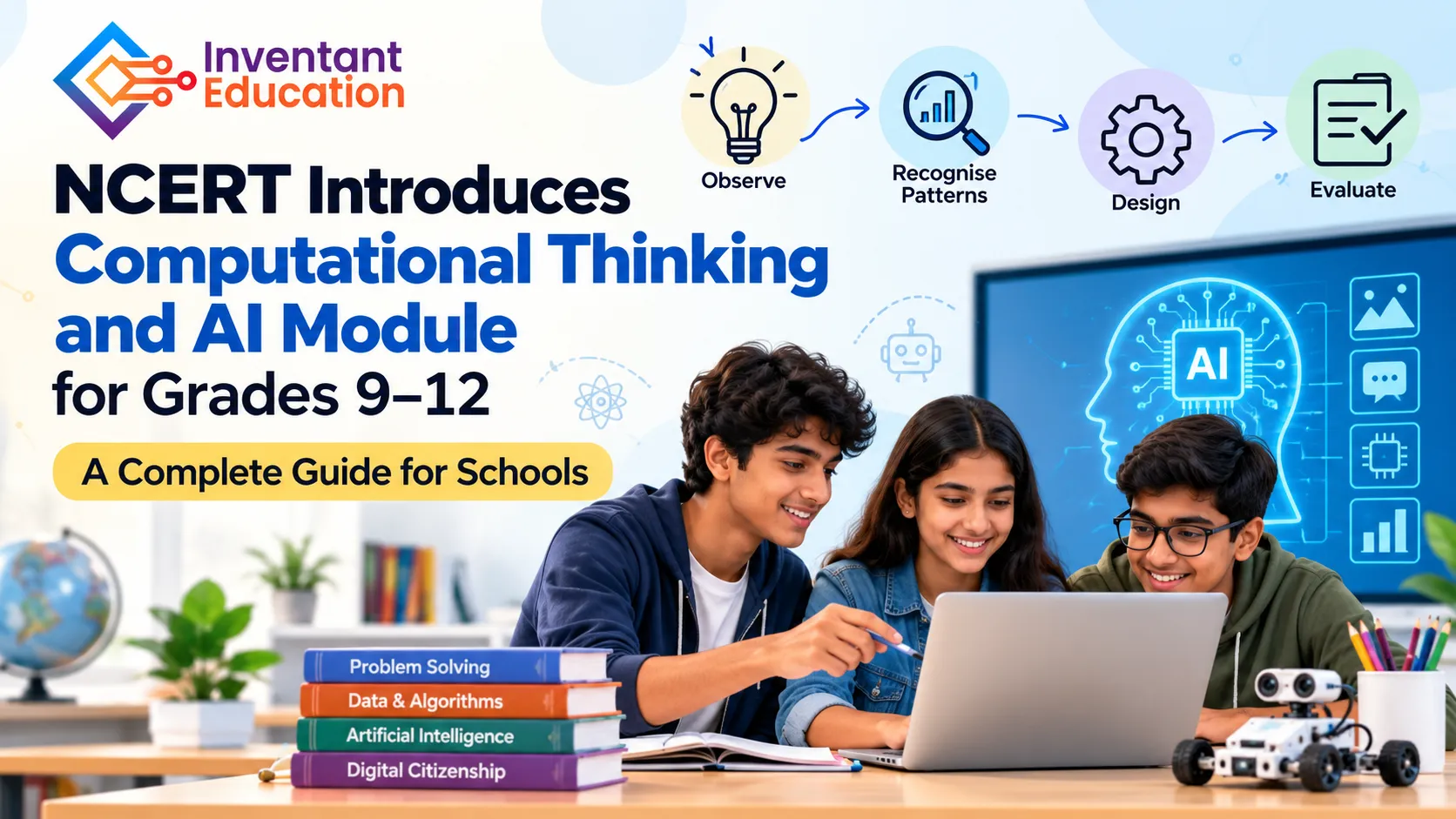
NCERT Introduces Computational Thinking and AI Module for Grades 9–12: A Complete Guide for Schools

Artificial Intelligence (AI) is changing how students learn, communicate, create, and solve problems. From language translation and digital payments to online recommendations and content creation, AI already plays a role in everyday life. Therefore, schools need to help students understand how these technologies work and how to use them responsibly.
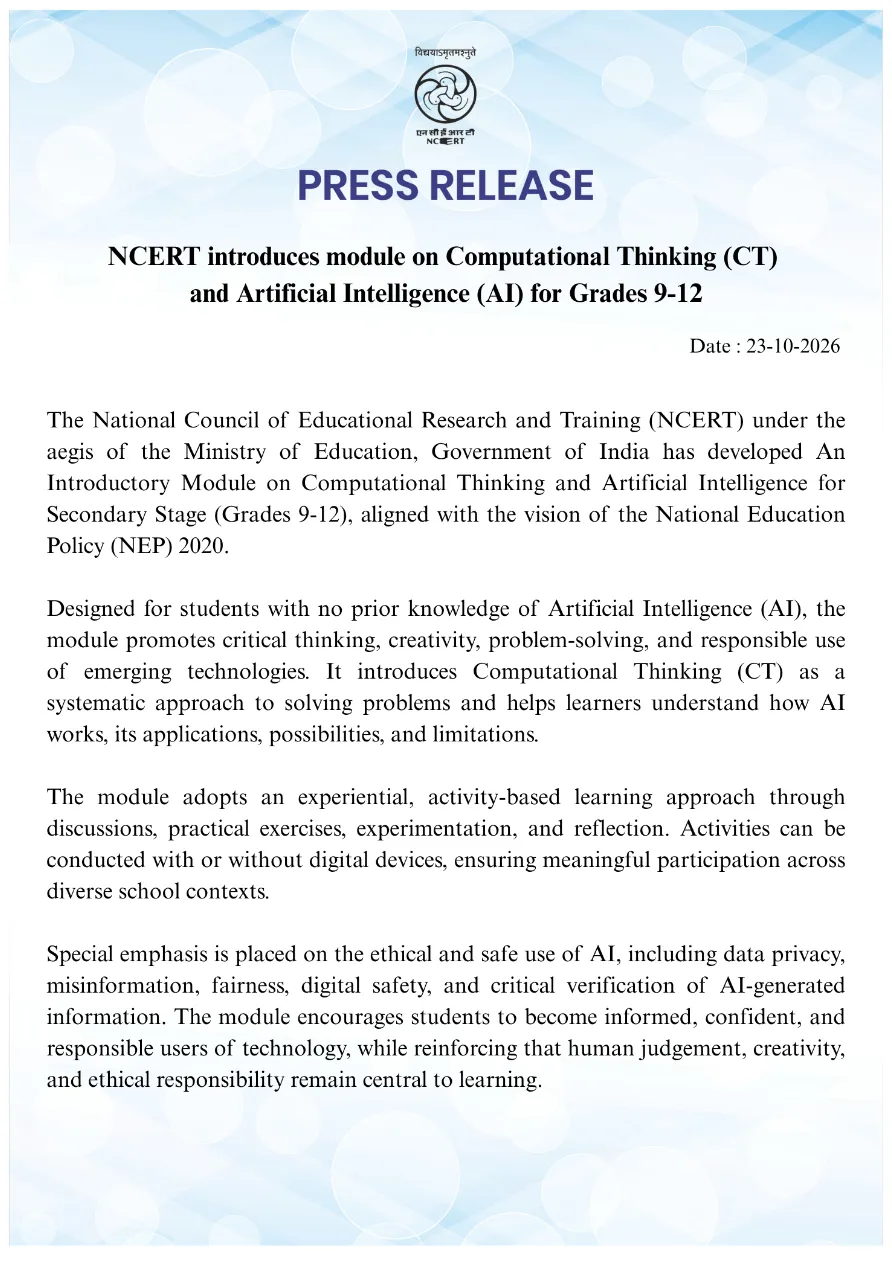
To support this goal, the National Council of Educational Research and Training (NCERT) has developed An Introductory Module on Computational Thinking and Artificial Intelligence for the Secondary Stage (Grades 9–12). Published in October 2026, the module aligns with the vision of the National Education Policy (NEP) 2020 and the National Curriculum Framework for School Education (NCF-SE) 2023.
The module introduces students to Computational Thinking (CT), AI, data, verification, privacy, and responsible technology use. More importantly, it focuses on practical learning and critical thinking rather than memorising technical definitions.
For school leaders, teachers, and academic coordinators, this resource offers valuable guidance on helping students become confident, careful, and responsible users of AI.
Read the official NCERT module: An Introductory Module on Computational Thinking and Artificial Intelligence for Grades 9–12 (PDF)
What Is the NCERT Computational Thinking and AI Module?
NCERT designed this introductory module to give students in Grades 9–12 a common foundation in Computational Thinking and Artificial Intelligence. Students do not need prior knowledge of AI or advanced technical skills to begin.
Rather than treating AI as a subject that requires coding alone, the module connects it with situations that students already encounter. These include searching for information, translating languages, receiving recommendations, using digital services, and creating content.
The module aims to help students:
- Recognise AI in everyday life and distinguish it from ordinary automation.
- Understand, in simple terms, how machines learn from examples.
- Evaluate AI-generated information before trusting it.
- Understand and protect their personal data.
- Use AI tools to support their thinking rather than replace it.
Consequently, the focus extends beyond technical knowledge. Students develop habits of observation, reasoning, evaluation, reflection, and responsible decision-making.
Why Are Computational Thinking and AI Important in School Education?
The NEP 2020 and NCF-SE 2023 emphasise critical thinking, creativity, problem-solving, experiential learning, and the application of knowledge in real-life situations.
Computational Thinking supports these goals by helping students approach problems systematically. At the same time, AI literacy helps them understand the technologies that increasingly influence everyday decisions.
Understanding Computational Thinking
Computational Thinking is a way of approaching problems through observation, pattern recognition, breaking complex situations into manageable parts, planning clear steps, testing solutions, and improving them through reflection.
Importantly, Computational Thinking does not require students to work on a computer at every stage. They can practise these habits through classroom discussions, paper-based exercises, everyday objects, and practical challenges.
For example, students can break a large task into smaller steps, identify repeated patterns in information, and compare different ways to reach a solution.
Understanding Artificial Intelligence
AI systems can recognise patterns in images, voices, text, and other forms of data. However, they do not always understand the wider context of a situation, and their outputs can be inaccurate or misleading.
Therefore, students need to learn how AI works at an introductory level, where it can help, where it may fail, and when they should verify its results.
Together, CT and AI education can help students approach new technologies with curiosity and critical judgement.
The Five Units of the NCERT CT and AI Module
NCERT organises the module into five units that build on one another. Each unit introduces a central question and develops practical habits through activities and reflection.
Unit 1: AI Is Already in Your Life
The first unit helps students identify AI in familiar situations. It explores pattern recognition and explains the difference between simple devices, rule-based automation, and AI systems that learn from examples.
For instance, students can explore how translation tools, recommendation systems, and certain banking systems use AI-related techniques.
The unit encourages students to observe their surroundings and question whether a system genuinely uses AI or simply follows fixed rules.
Key learning activity: AI Diary
Students record examples of AI they encounter in everyday life. This activity helps them connect classroom learning with real-world experiences.
Unit 2: How Machines Learn from Examples
The second unit introduces the idea that machines can learn patterns from examples. Students explore data, features, categories, and the ways that training examples influence a system’s behaviour.
They also examine how uneven or incomplete training data can lead to bias or poor results.
Rather than viewing AI as a system that always produces the correct answer, students learn that its performance depends on the examples it receives and the task it attempts.
Key learning activity: Train-and-Break Log
Students train a simple image classifier and then try to identify situations in which it fails. They can observe how changing the examples affects the system’s performance.
This activity encourages experimentation and helps students understand why testing matters.
Unit 3: When AI Gets It Wrong
AI tools can produce confident answers that contain mistakes. They can also generate misleading content or present unsupported claims as facts.
The third unit helps students recognise these limitations and develop a practical approach to checking AI-generated information.
It also addresses deepfakes, synthetic media, evaluation, and the role of human judgement.
Key learning activities: Verification Checklist and Hallucination Hunt
Students examine AI-generated answers, investigate questionable claims, and practise checking sources. They learn to distinguish between an answer that sounds convincing and one that has reliable supporting evidence.
The unit introduces the Five Checks:
- Source: Where did the information come from?
- Claim type: What kind of claim does the AI make, and how can someone verify it?
- Compare: Do the cited sources support the claim? Do independent sources agree?
- Pause: Have personal assumptions or an overly confident tone influenced the judgement?
- Confidence: How strong is the evidence, and how certain should the student be?
By practising these checks, students can make better decisions before using or sharing AI-generated information.
Unit 4: Your Data, Your Rights, Your Responsibility
AI tools often depend on data. Therefore, students need to understand what information they share, how platforms may use it, and why privacy matters.
This unit explores identifying data, behavioural data, sensitive personal data, inferred data, consent, fairness, inclusion, and responsible technology use.
It also encourages students to examine privacy policies and consider how applications collect, share, retain, and remove personal information.
Key learning activity: Privacy Policy Dissection
Students examine the privacy policy of an application they use and investigate five questions:
- What kinds of data does the application collect?
- Why does it collect that information?
- With whom does it share the data?
- How long does it retain the data?
- How can users delete their accounts and request data removal?
This activity develops practical awareness of data privacy and digital responsibility.
Unit 5: Working with Modern AI Tools — Prompts and the Helper Stance
The final unit brings together the habits developed throughout the module. Students explore how to ask clearer questions, provide useful context, review responses, and improve their prompts.
The module distinguishes between two approaches to AI use:
- Helper stance: Students do the thinking while AI supports their work.
- Replacement stance: Students allow AI to do the thinking in their place.
The helper stance supports learning because students remain responsible for their reasoning, decisions, and final work.
Key learning activity: Prompt Library
Students create and improve prompts for tasks that matter to them. They review the responses, refine their instructions, and reflect on the results.
The module identifies Unit 5 as the concluding practical unit and notes that teachers can decide whether and how to run it. It also provides offline alternatives for classrooms without access to AI tools.
How Does NCERT Recommend Teaching the Module?
The module prioritises active participation, practical experience, discussion, and reflection. Teachers do not need to present every concept as a formal technical definition. Instead, they can help students discover ideas through observation, experimentation, and questions.
NCERT outlines three activity modes to accommodate different school environments.
1. Full Mode
Students use individual devices or share devices in pairs to complete hands-on activities.
2. Teacher-Demonstration Mode
Teachers demonstrate an activity on a shared screen while students observe, discuss, and analyse the results.
3. Unplugged Mode
Students complete activities through paper, everyday objects, observation, and discussion without digital tools.
All three modes aim to teach the same core ideas. As a result, schools can adapt activities to available resources without automatically excluding students who lack personal devices or reliable internet access.
What Is the 20-Hour Teaching Plan?
The NCERT teacher guidance includes a suggested plan organised across 20 class hours. It sequences the five units so that each activity builds on earlier learning.
The plan moves from identifying AI in everyday life to understanding machine learning, checking AI outputs, protecting personal data, and working with AI tools.
Core activities form part of the guided 20-hour delivery plan. Enrichment activities offer additional opportunities for exploration.
Teachers can organise sessions around a short introduction, a practical activity, discussion, and a reflection task. The module recommends giving substantial classroom time to student participation rather than relying only on teacher explanations.
Schools should consult the official module for the detailed session-wise plan and the guidance for adapting activities to their own classrooms.
The Curious Notebook: Learning Through Reflection
One of the module’s central features is the Curious Notebook, a running record of students’ observations, reasoning, experiments, revisions, and reflections.
Students add work from each unit to this portfolio. Depending on the units covered, the work may include:
- An AI Diary.
- A Train-and-Break Log.
- A verification checklist and Hallucination Hunt record.
- A Privacy Policy Dissection.
- A Prompt Library and reflection notes, where Unit 5 is undertaken.
The notebook helps teachers observe how students develop their thinking over time. It also provides evidence of learning beyond correct answers alone.
For example, a student may make an incorrect prediction, investigate the result, and revise the original explanation. That process can demonstrate meaningful learning.
Teachers can use the notebook for formative assessment and provide short feedback as students progress.
How Does the Module Promote Responsible AI Use?
The module integrates ethical and safe technology use into the learning process rather than treating it as a separate topic.
It encourages students to protect personal information, verify important claims, recognise misleading or harmful content, and seek help from a trusted adult when necessary.
Schools can reinforce these habits through classroom discussions and practical examples.
Protect Personal Information
Students should not enter passwords, one-time passwords, Aadhaar or PAN details, photographs of identity documents, or other sensitive personal information into AI tools.
Verify Before Trusting
An AI tool may produce an answer that sounds convincing but contains errors. Students should check important claims against reliable sources before using or sharing them.
Recognise Bias and Unfairness
AI systems may perform poorly for some groups or produce unfair results. Students should question the examples and assumptions behind an output instead of accepting it automatically.
Handle Harmful Content Carefully
If students encounter upsetting content or material that targets them or someone else, they should not forward it. Instead, they should seek help from a trusted adult and follow the relevant school or official reporting process.
These practices help students develop responsible digital citizenship while learning about emerging technologies.
What Should Schools and Teachers Do Next?
The NCERT module gives schools a practical starting point for introducing Computational Thinking and AI literacy at the secondary stage.
School leaders and academic coordinators can begin by reviewing the module and identifying suitable opportunities for classroom implementation.
Schools can take the following steps:
- Review the official module: Understand the five units, learning outcomes, and suggested teaching plan.
- Plan classroom activities: Select suitable activities for students in Grades 9–12.
- Prepare teachers: Encourage educators to explore the activities and model careful verification.
- Adapt to available resources: Use full, teacher-demonstration, or unplugged modes according to classroom needs.
- Encourage reflection: Use the Curious Notebook to record student observations, experiments, and revisions.
- Reinforce responsible AI use: Discuss privacy, fairness, misinformation, and appropriate use of AI tools.
- Check official guidance: Refer to NCERT and relevant board communications for applicable curriculum and implementation instructions.
These steps can help schools turn the module’s concepts into meaningful learning experiences.
How Inventant Education Supports Future-Ready Learning
Future-ready education involves more than introducing students to new technologies. It also requires opportunities to develop creativity, logical reasoning, problem-solving, collaboration, and responsible digital behaviour.
At Inventant Education, we believe that meaningful technology education should connect concepts with practical learning. School resources and hands-on experiences can help students explore ideas, test solutions, and build confidence through experimentation.
As schools explore Computational Thinking and AI education, educators can consider how their existing learning resources, classroom activities, and technology programmes support these wider learning goals.
The objective is not simply to teach students how to use tools. It is to help them understand problems, ask better questions, evaluate information, and make thoughtful decisions.
Conclusion: Preparing Students for an AI-Enabled Future
NCERT’s An Introductory Module on Computational Thinking and Artificial Intelligence for Grades 9–12 provides a structured foundation for helping students understand AI and develop responsible technology habits.
Its five units cover everyday AI, learning from examples, verification, data privacy, and the use of modern AI tools. Moreover, the module’s activity-based approach, flexible teaching modes, and Curious Notebook support learning through observation, experimentation, and reflection.
For schools and teachers, the key takeaway is clear: AI education should develop critical thinking alongside technical awareness. Students need to know not only what AI can do but also when to question its outputs, protect their data, and rely on their own judgement.
By combining Computational Thinking, AI literacy, and responsible digital citizenship, schools can help students prepare for a future in which technology continues to evolve.
Explore the official NCERT module: Download An Introductory Module on Computational Thinking and Artificial Intelligence for Grades 9–12
Frequently Asked Questions (FAQs)
1. What is the NCERT CT and AI module for Grades 9–12?
It is an introductory module developed by NCERT to help secondary-stage students understand Computational Thinking, Artificial Intelligence, verification, data privacy, and responsible technology use.
2. Is prior knowledge of AI required?
No. The module assumes no prior knowledge of Artificial Intelligence.
3. What are the five units in the NCERT AI module?
The units are AI Is Already in Your Life; How Machines Learn from Examples; When AI Gets It Wrong; Your Data, Your Rights, Your Responsibility; and Working with Modern AI Tools: Prompts and the Helper Stance.
4. How much classroom time does the module suggest?
The teacher guidance provides a suggested 20-hour plan. Teachers can consult the official module for the session-wise structure and activity details.
5. Can schools teach the module without computers or internet access?
Yes. The module provides unplugged activities using paper, everyday objects, observation, and discussion. Teachers can also use demonstration-based activities.
6. What is the Curious Notebook?
The Curious Notebook is a student portfolio that records work, observations, experiments, verification activities, and reflections across the module.
7. How does the module teach students to verify AI-generated information?
It introduces the Five Checks: Source, Claim type, Compare, Pause, and Confidence. Students use these steps to evaluate claims and determine whether an AI output deserves trust.
8. Why does the module emphasise data privacy?
Students need to understand the personal information they share with digital tools, how applications may use their data, and how to protect themselves from misuse.
9. Is Unit 5 compulsory?
The module’s teacher guidance describes Unit 5 as optional and leaves the decision about whether and how to run it to the teacher. Schools should consult the official module and applicable board instructions for implementation decisions.
10. Where can teachers download the official NCERT module?
Teachers can access the PDF directly from the NCERT website.
Source: National Council of Educational Research and Training (NCERT), An Introductory Module on Computational Thinking and Artificial Intelligence for the Secondary Stage (Grades 9–12), October 2026.