☎ 1800 202 2912 | +91 9717773968 | info@inventanteducation.com

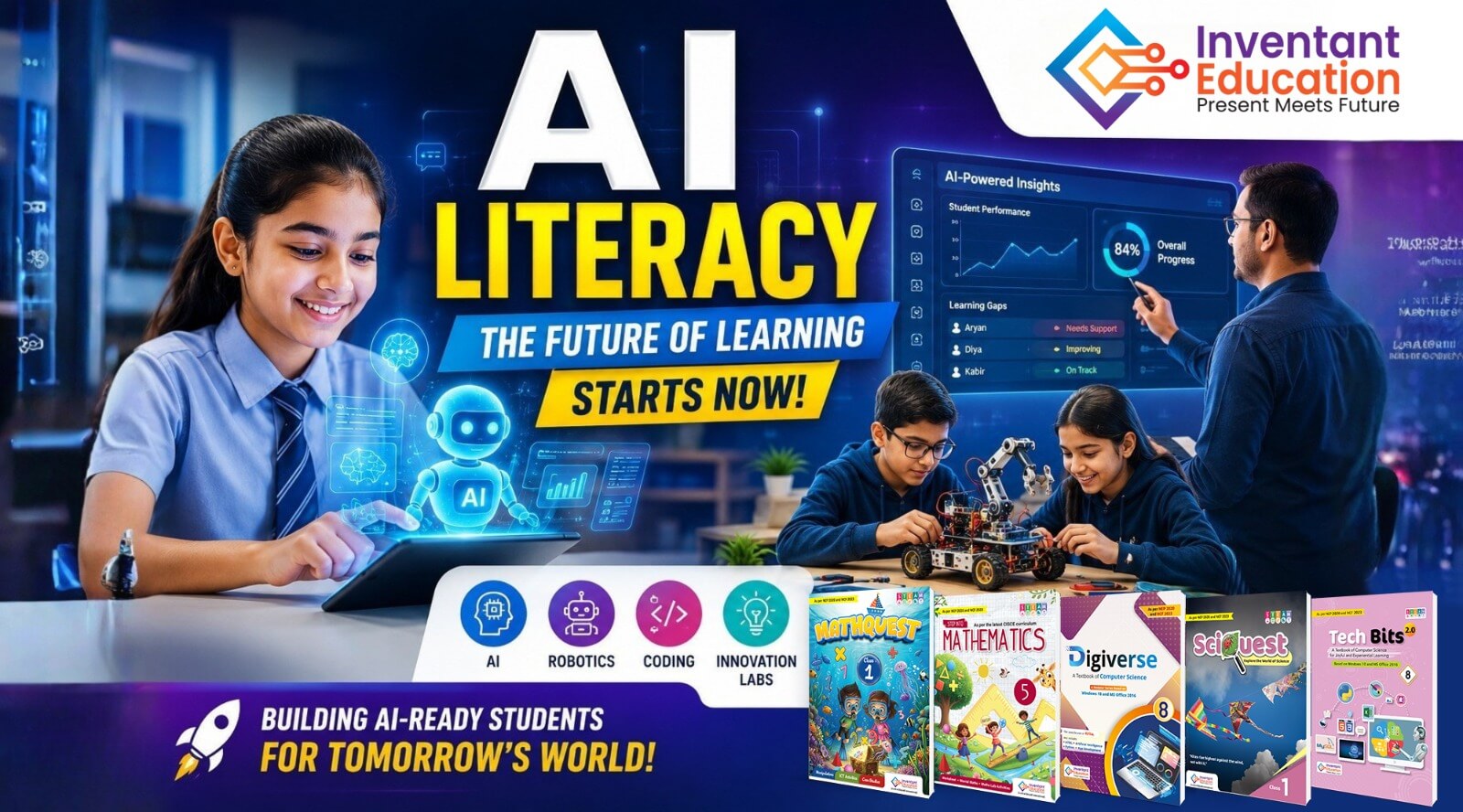
AI Literacy in Indian Classrooms: Why 2026 Is the Year Everything Changes

India, STEM education India, AI textbooks India
Introduction: The Classroom Is No Longer Just a Room
Imagine a Class 9 student in Noida using an AI-powered learning app to explore a difficult concept. Meanwhile, a teacher in Chennai uses digital assessment tools to identify students who need extra support in algebra. In Pune, a school introduces robotics and machine learning projects during its annual science week.
These examples illustrate how technology can transform learning in Indian classrooms.
In 2026, AI literacy in Indian classrooms has become an increasingly important educational priority. Schools are exploring new ways to help students understand artificial intelligence, use digital tools responsibly, and develop the skills they will need in a technology-driven world.
However, introducing AI into education involves more than providing students with access to digital tools. Schools must also teach learners how AI works, where it can fail, and how to evaluate its outputs critically.
What Is AI Literacy, and Why Does It Matter?
AI literacy does not mean turning every student into a programmer or data scientist. Instead, it means helping learners understand, use, evaluate, and interact responsibly with artificial intelligence in academic and everyday situations.
Consider computer literacy. During the 1990s, computer skills gave learners a valuable advantage. Today, digital skills have become essential across many professions. Similarly, AI literacy is becoming increasingly relevant as artificial intelligence influences education, communication, research, and the workplace.
Moreover, students need more than the ability to operate AI tools. They must learn to question AI-generated answers, recognise inaccurate information, protect personal data, and understand the ethical implications of automated decisions.
For this reason, schools should introduce AI concepts through age-appropriate lessons, practical activities, and critical-thinking exercises.
How India Is Advancing AI Education
India’s education system is increasingly exploring artificial intelligence, computational thinking, and technology-enabled learning. Government initiatives, curriculum developments, and educational technology platforms are contributing to this shift.
For example, the National Education Policy (NEP) 2020 emphasises experiential learning, critical thinking, flexibility, and multidisciplinary education. These priorities support learning approaches that help students understand technology and apply their knowledge to real-world problems.
In addition, CBSE’s Computational Thinking and Artificial Intelligence curriculum resources for Classes 3–8 in 2026–27 provide schools with a framework for developing these skills at an early age.
For schools, the opportunity is clear: introduce students to computational thinking, build their understanding of AI gradually, and connect classroom learning with practical applications.
Editorial note: Verify any specific Union Budget allocation or survey finding against its original official source before publication. Avoid presenting proposed funding or survey results as confirmed facts without a citation.
From Engineering Labs to Every Classroom
Traditionally, schools often introduced advanced computer science topics in the higher classes. However, educators can introduce the foundations of computational thinking much earlier through puzzles, storytelling, sorting activities, and logical reasoning games.
As students progress, teachers can introduce more complex concepts.
- Primary classes: Students explore patterns, sequencing, logical reasoning, and step-by-step instructions.
- Middle school: Learners develop problem-solving skills, work with data, and explore introductory AI concepts where appropriate.
- Secondary classes: Students can investigate AI applications, experiment with digital tools, develop projects, and discuss responsible technology use.
As a result, students can build their understanding gradually rather than encountering AI as an unfamiliar subject in their later school years.
This approach also reflects the growing importance of hands-on, interdisciplinary learning. Instead of memorising definitions alone, students can investigate problems, test ideas, and explain their reasoning.
This is the educational approach that Inventant Education supports through its computer science books, AI learning resources, and practical STEM offerings.
How Inventant Education Supports AI Literacy
Quality learning resources play an important role in making artificial intelligence accessible to school students. Teachers need materials that explain complex concepts clearly, connect theory with practice, and support classroom learning.
Inventant Education, a unit of Edulabz International and a sister concern of Goyal Brothers Prakashan, offers educational resources designed to support computer science, AI, and STEM learning.
1. A Concise Course in Artificial Intelligence — Subject Code 417
Inventant Education’s A Concise Course in Artificial Intelligence supports CBSE students studying Artificial Intelligence in Classes 9 and 10.
The textbook introduces learners to AI concepts and applications through structured educational content. Furthermore, it can help teachers connect theoretical knowledge with examples of how artificial intelligence works in everyday life.
By building a foundation in AI concepts, students can develop a clearer understanding of the technology they encounter beyond the classroom.
2. Tech Infinity and Tech Trails 2.0
Computer science education should go beyond memorising terminology or writing code for examinations. Students also need opportunities to develop logical reasoning, understand computational processes, and apply technology to practical problems.
Inventant Education’s Tech Infinity and Tech Trails 2.0 series support computer science learning through structured educational content and technology-focused activities.
Consequently, these resources can help schools connect foundational digital skills with the broader demands of technology education.
3. AI and Robotics Innovation Labs by Edulabz
Hands-on learning gives students an opportunity to turn abstract ideas into practical experiences.
Through AI and Robotics Innovation Labs, Edulabz supports experiential learning with application-based activities and DIY projects. Students can explore robotics, investigate how technological systems work, and practise problem-solving through experimentation.
For example, a classroom project might ask learners to design a simple automated solution to a familiar problem. In doing so, students can practise planning, testing, debugging, and evaluating their designs.
4. Edu Invent App
Digital learning platforms can extend classroom learning beyond school hours. Edu Invent brings together digital learning resources, including e-books, video lectures, animated lessons, practice exercises, and self-assessment tools.
In addition, its assessment-related features can help teachers prepare learning activities and evaluate student understanding.
When schools combine digital resources with teacher guidance and classroom discussion, students gain more opportunities to revisit concepts and practise at their own pace.
Explore Inventant Education’s AI, Computer Science, and STEM resources:
- Website: www.inventanteducation.com
- Phone: 1800 202 2912
- Mobile: +91 9717773968
Why Schools Should Prioritise AI Literacy
AI literacy can help schools prepare students for a world in which people increasingly interact with intelligent digital systems. Nevertheless, schools should approach this change thoughtfully rather than adopting technology simply because it is new.
Here are three important reasons to prioritise AI education.
1. Students need stronger problem-solving skills.
Computational thinking encourages learners to break down problems, recognise patterns, and develop step-by-step solutions. These skills can support learning across mathematics, science, and other subjects.
2. Teachers can explore new approaches to learning.
When used appropriately, AI-enabled tools can help teachers generate practice materials, adapt explanations, and identify areas where students may need additional support. However, teachers must review AI-generated content for accuracy and suitability.
3. Schools must prepare students for technological change.
As AI tools become more common across industries, students need to understand their capabilities and limitations. Early exposure can help learners become more confident, critical, and responsible technology users.
Moreover, schools that combine suitable learning resources, teacher development, and practical activities can create a stronger foundation for AI education.
What Should Schools and Educators Do Right Now?
Schools do not need to transform every classroom overnight. Instead, they can take a structured approach to introducing AI literacy.
1. Review the Existing Curriculum
First, examine the school’s current computer science and STEM curriculum. Identify where students already practise logical reasoning, problem-solving, data handling, and digital skills.
Next, map these activities against the relevant curriculum requirements. This process will help teachers identify learning gaps and plan suitable improvements.
2. Choose Appropriate Learning Resources
The right textbooks and teaching materials can make unfamiliar concepts easier to understand. Therefore, schools should evaluate resources for curriculum alignment, age appropriateness, conceptual clarity, practical activities, and assessment support.
Inventant Education offers computer science, AI, and STEM learning resources that schools can explore when planning their programmes.
3. Move Beyond Theory
Students learn by doing. For example, teachers can use sequencing games, data-classification exercises, coding challenges, and robotics activities to connect abstract concepts with real situations.
As students progress, teachers can introduce projects that require learners to define a problem, develop a solution, test their ideas, and explain their results.
4. Support Teacher Development
Teachers play a central role in effective AI education. Although digital tools can support instruction, educators still need to guide discussions, correct misconceptions, and help students evaluate information critically.
Therefore, schools should provide opportunities for teachers to explore AI tools, practise classroom activities, discuss ethical considerations, and share effective teaching strategies.
5. Combine Classroom Teaching with Digital Learning
Digital platforms can reinforce lessons and provide additional practice. For example, students can revisit an explanation through a video lesson, complete a practice exercise, and use feedback to identify concepts they need to review.
However, digital learning should complement teacher-led instruction rather than replace meaningful classroom interaction.
The Bottom Line: AI Literacy Is Becoming Essential
India’s education system is entering an important period of technological change. Policy priorities, curriculum developments, and new learning resources are creating opportunities for schools to introduce students to computational thinking and artificial intelligence.
However, successful AI education requires more than access to software or devices. Students need clear explanations, practical activities, responsible-use guidance, and teachers who can help them think critically about technology.
This is where educational publishers and learning-resource providers such as Inventant Education can contribute by supporting schools with computer science books, AI resources, digital learning materials, and hands-on STEM experiences.
Ultimately, the goal is not simply to teach students how to use today’s AI tools. It is to help them become thoughtful learners who can question information, solve problems, adapt to change, and use technology responsibly.
The question for schools is no longer just whether students will encounter AI. It is how effectively educators can prepare them to understand and use it.
About Inventant Education
Inventant Education is a STEM-focused educational publisher, a unit of Edulabz International and a sister concern of Goyal Brothers Prakashan. The organisation offers educational books, digital learning resources, and practical STEM learning solutions for schools.
Through its focus on technology education and experiential learning, Inventant Education aims to help educators make computer science, AI, and STEM concepts more accessible to students across different stages of schooling.
Visit Inventant Education to explore its educational resources.