☎ 1800 202 2912 | +91 9717773968 | info@inventanteducation.com

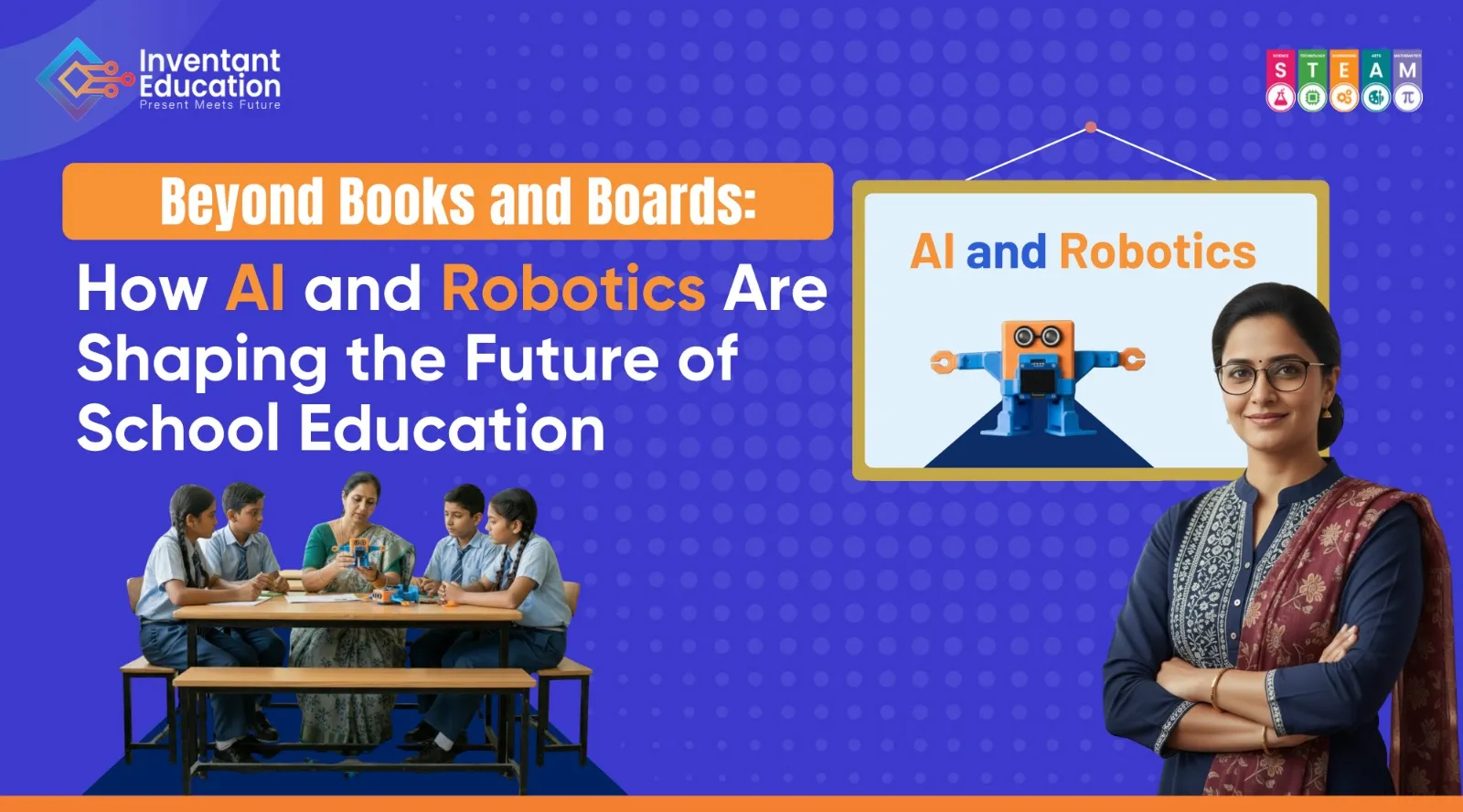
Beyond Books and Boards: How AI and Robotics Are Shaping the Future of School Education

Not long ago, classrooms were defined by chalkboards, textbooks, and one-way teaching. The teacher explained, students listened, notes were copied, and learning was often measured by how much a child could remember.
But the world outside the classroom has changed dramatically.
Today’s students are growing up in a world of smart devices, automation, data, and artificial intelligence. The skills required for success are no longer limited to memorisation. They include critical thinking, creativity, problem-solving, and adaptability.
This is where AI and Robotics are transforming education, not as additional subjects, but as powerful tools that turn classrooms into spaces of exploration, innovation, and real understanding.
Why the Shift is Necessary Today
Education is no longer just about preparing students for exams. It is about preparing them for a future where:
- Jobs will be technology-driven
- Problem-solving will matter more than memorisation
- Creativity and innovation will define success
- Learning will be continuous and self-driven
If classrooms continue to rely solely on traditional methods, the gap between school learning and real-world requirements will keep widening.
AI and Robotics help bridge this gap by bringing real-world thinking into everyday learning.
From Passive Learning to Active Understanding
In traditional classrooms, learning often happens in a passive format:
- Teacher explains
- Students copy
- Homework reinforces memorisation
But true learning happens when students experience concepts.
Imagine a student learning about angles in mathematics. Instead of only drawing a 90-degree angle on paper, the student programs a robot to turn exactly 90 degrees. If the robot turns only 87 degrees, the student has to:
- Identify the error
- Modify the logic
- Test again
This process transforms learning into:
- Thinking instead of copying
- Experimenting instead of memorising
- Understanding instead of recalling
That is the real power of AI and Robotics in education.
Building the Skills That the Future Demands
Technology integration is not just about machines; it is about developing essential life skills.
When students work with AI and Robotics, they naturally develop:
- Logical and computational thinking
- Problem-solving abilities
- Creativity and innovation
- Collaboration and teamwork
- Decision-making skills
- Confidence to experiment and learn from mistakes
These are the very skills emphasised under NEP 2020 and global education frameworks.
More importantly, students begin to enjoy learning because it becomes interactive, meaningful, and relevant.
How AI and Robotics Support Learning Across School Levels
Primary Level: Learning Through Curiosity and Play
At the foundational stage, children learn best through visuals, activities, and exploration.
AI and Robotics help them:
- Understand numbers, patterns, and sequences
- Build early logical thinking
- Learn through drag-and-drop coding
- Experience gamified learning
Concepts that once felt abstract become simple and enjoyable.
Middle School: Applying Knowledge to Real Situations
At this stage, students begin connecting classroom learning to practical applications.
They use technology to:
- Create shapes using correct angles and measurements
- Understand direction, motion, and geometry
- Work in teams to solve challenges
- Analyze errors and improve accuracy
This stage builds confidence, collaboration, and analytical thinking.
Secondary Level: Technology as a Learning Laboratory
In higher classes, AI and Robotics become powerful academic tools.
Students can:
- Conduct experiments and record data
- Analyze motion, time, and energy
- Apply concepts from physics, mathematics, and science
- Develop inquiry-based and research-oriented thinking
Here, robotics is not the learning goal, it becomes a medium to develop a scientific mindset.
Empowering Teachers, Not Replacing Them
One of the biggest concerns around technology in education is the fear that it may reduce the role of teachers.
In reality, the opposite is happening.
AI helps teachers:
- Create lesson plans faster
- Generate worksheets and assessments
- Personalize content for different learners
- Track learning patterns and progress
This saves time and allows teachers to focus on:
- Mentoring students
- Guiding discussions
- Encouraging creativity
- Designing meaningful learning experiences
Technology handles the routine work.
Teachers focus on human connection and deeper learning.
The role of the teacher is not reduced; it is elevated.
Understanding the Power of AI and Robotics Together
Both technologies play different but complementary roles:
- Robotics provides hands-on execution and physical interaction
- AI provides analysis, personalisation, and decision support
Together, they help students:
- Plan
- Test
- Analyze
- Improve
This cycle builds real understanding and independent thinking.
Learning Responsibility Along With Technology
While technology opens new possibilities, it also requires responsible use.
Students must learn to:
- Verify AI-generated information
- Ask questions instead of blindly accepting answers
- Protect personal data and privacy
- Use digital tools ethically
Responsible and ethical use of technology is not just a technical skill; it is a life skill.
Parents and teachers play a crucial role in guiding students toward safe and mindful digital behaviour.
Why Schools Need to Act Now
Integrating AI and Robotics is no longer an option; it is a necessity for schools that want to stay relevant and future-ready.
Schools that adopt these technologies benefit from:
- Alignment with NEP 2020 and competency-based education
- Improved student engagement and learning outcomes
- Enhanced school reputation and innovation culture
- Better preparation for future careers and global opportunities
Most importantly, they create classrooms where students are excited to learn.
The Future of Education: From Teaching to Innovation
The purpose of education is evolving.
It is no longer about delivering information.
It is about developing thinkers, problem-solvers, and innovators.
AI and Robotics help transform classrooms into:
- Interactive learning environments
- Inclusive spaces for diverse learners
- Experiential and hands-on ecosystems
- Innovation hubs for future-ready students
When technology supports good pedagogy and strong teacher guidance, learning becomes powerful and meaningful.
Conclusion
The future belongs to learners who can think, adapt, and innovate. By integrating AI and Robotics into everyday teaching, schools are not just upgrading their infrastructure; they are transforming the way students learn and grow.
The classroom is no longer just a place to study.
It is becoming a space to explore, create, and innovate.
And that is the future of education.