☎ 1800 202 2912 | +91 9717773968 | info@inventanteducation.com

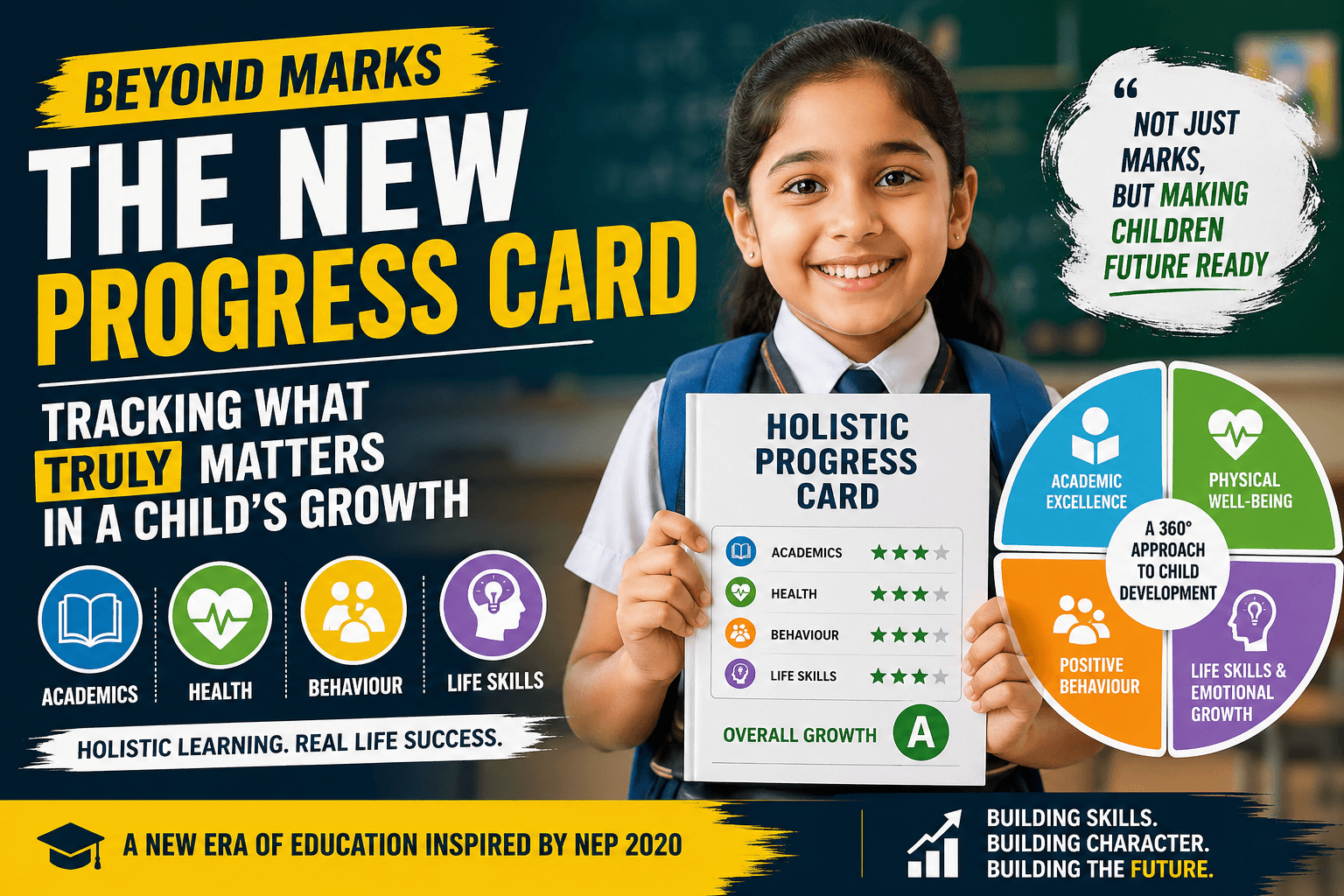
Beyond Marks: How India’s New Holistic Progress Cards Are Redefining Education

India’s education system is undergoing a fundamental transformation. For decades, marks defined intelligence, success, and even identity. However, with rapid technological shifts, changing job markets, and increasing awareness around mental health and skill-based learning, the traditional system is now being challenged.
The introduction of holistic progress cards marks a critical shift from marks-driven evaluation to multi-dimensional assessment. This blog explores the depth of this transformation, its rationale, implementation, global comparisons, psychological impact, and future implications.
The Historical Context of Assessment in India
The Indian education system has long been rooted in exam-centric evaluation. From board exams to competitive entrance tests, performance has been reduced to numerical scores. While this system ensured standardisation, it also ignored creativity, emotional intelligence, and practical skills.
Over time, this led to systemic issues such as rote learning, coaching culture, and intense academic pressure. Students began optimizing for marks rather than knowledge or skill development.
Limitations of the Traditional System
The traditional report card system suffers from several limitations:
1. It measures memory rather than intelligence.
2. It ignores non-academic talents.
3. It creates unhealthy competition.
4. It fails to prepare students for real-world challenges.
These gaps have become more visible in the modern world, where adaptability, creativity, and collaboration are critical skills.
The Emergence of Holistic Progress Cards
The holistic progress card is designed to capture a 360-degree view of a student. It includes academic performance, behavioral traits, emotional development, and life skills.
This approach aligns with global education trends and frameworks like NEP 2020, which emphasize competency-based learning and student-centric education.
Key Components of the New Evaluation System
1. Academic Learning: Focus on conceptual understanding rather than rote memorisation.
2. Health & Physical Fitness: Tracking physical activity and well-being.
3. Behavioural Development: Assessing discipline, empathy, and social interaction.
4. Life Skills: Communication, leadership, and problem-solving.
5. Emotional Intelligence: Self-awareness, resilience, and adaptability.
Case Study: Gurgaon’s Implementation
Gurgaon schools have begun implementing these new progress cards for primary students. Teachers now maintain continuous observation logs and provide descriptive feedback instead of just marks.
Initial observations suggest improved student engagement and reduced anxiety. Parents are also gaining better insights into their child’s holistic development.
Psychological Impact on Students
Research shows that reducing emphasis on marks can significantly lower stress levels. Students become more curious, engaged, and willing to experiment.
Holistic evaluation encourages intrinsic motivation rather than fear-based learning. This leads to deeper understanding and long-term retention.
Impact on Teachers and Pedagogy
Teachers are transitioning from instructors to facilitators. Their role now includes mentoring, observing, and guiding students’ overall development.
This requires new training modules, digital tools, and structured evaluation frameworks.
Global Comparisons
Countries like Finland and Canada have long adopted holistic education systems. Their focus on creativity, collaboration, and well-being has resulted in high student satisfaction and strong learning outcomes.
India’s shift brings it closer to these global standards.
Challenges in Implementation
Despite its advantages, the system faces challenges:
- Subjectivity in evaluation
- Increased workload for teachers
- Resistance from parents
- Need for infrastructure and training
Addressing these challenges is critical for successful adoption.
Future of Education in India
The future classroom will be dynamic, skill-driven, and technology-enabled. AI, robotics, and experiential learning will play a key role.
Students will be evaluated based on their ability to think, adapt, and collaborate rather than memorize.
The shift to holistic progress cards is a societal transformation. It redefines success, intelligence, and growth. If implemented effectively, it can create a generation of confident, skilled, and emotionally intelligent individuals ready for the future.