☎ 1800 202 2912 | +91 9717773968 | info@inventanteducation.com

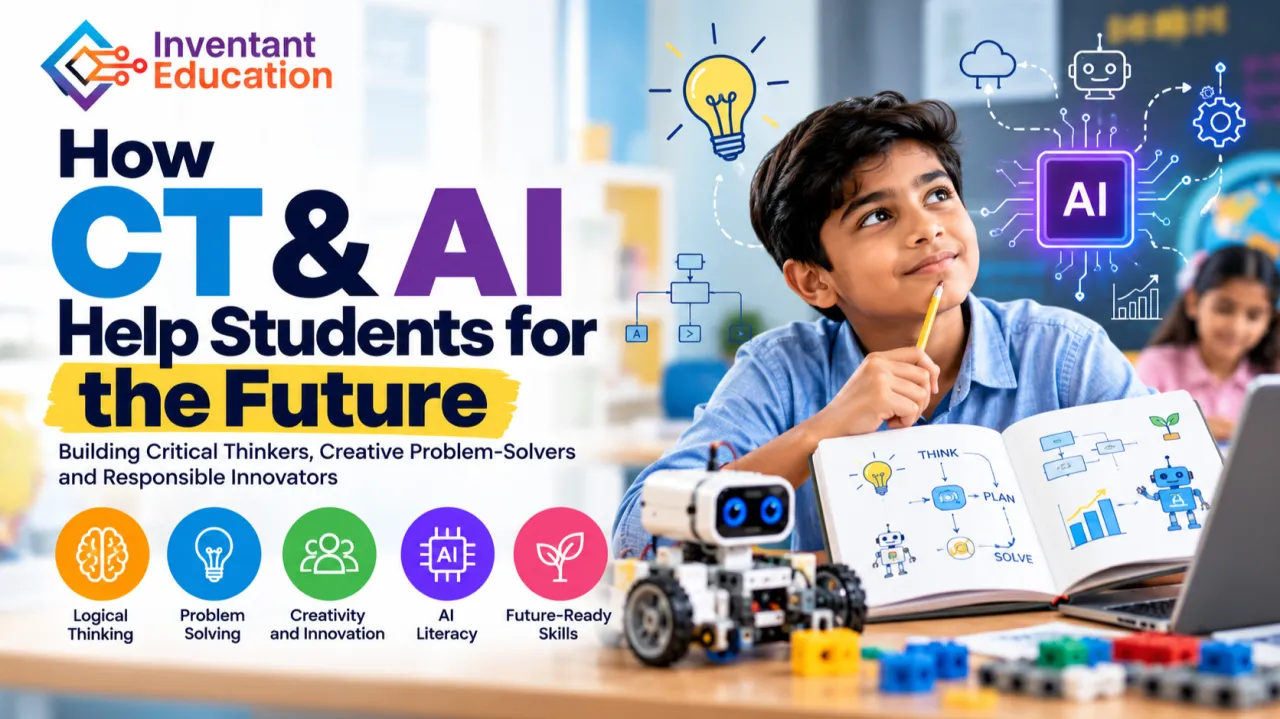
How Computational Thinking (CT) and Artificial Intelligence (AI) Prepare Students for the Future

Introduction: Preparing Students for a World That Is Constantly Changing
The world is changing faster than ever. Artificial Intelligence is transforming industries, automation is reshaping workplaces, and digital technologies are influencing how people communicate, learn, create and solve problems. In this rapidly evolving environment, preparing students for the future requires more than teaching them facts, formulas and established concepts. It requires helping them develop the ability to think independently, adapt to change and apply their knowledge to real-world challenges.
This is where Computational Thinking (CT) and Artificial Intelligence (AI) become important components of modern school education.
Computational Thinking helps students approach problems logically, identify patterns, break complex challenges into manageable steps and develop systematic solutions. Artificial Intelligence education helps them understand how intelligent technologies work, how these technologies influence everyday life, and how to use them responsibly.
Together, CT and AI can help students become active problem-solvers and informed digital citizens rather than passive users of technology.
Recognising this importance, the Central Board of Secondary Education (CBSE) launched its Computational Thinking and Artificial Intelligence curriculum for Classes III–VIII for the 2026–27 academic session, with an emphasis on problem-solving, logical reasoning, digital literacy, innovation and responsible technology use. This initiative aligns with the broader educational direction outlined in India’s National Education Policy (NEP) 2020 and the National Curriculum Framework for School Education (NCF-SE) 2023. Source: CBSE curriculum circular.
But what do CT and AI actually mean for students, and how can schools integrate these concepts into meaningful learning experiences?
1. What Is Computational Thinking, and Why Do Students Need It?
Computational Thinking is a structured approach to problem-solving. It involves understanding a problem, identifying relevant information, recognising patterns, developing a sequence of steps and testing whether a solution works.
Although the term includes the word “computational,” CT is not limited to computer programming. Students can practise computational thinking through mathematics, science experiments, classroom activities, puzzles, games and everyday decision-making.
The CBSE CT and AI curriculum identifies key elements of computational thinking, including decomposition, pattern recognition, abstraction, algorithm design, data analysis and troubleshooting.
The key components of Computational Thinking
Decomposition: Breaking complex problems into smaller parts
Students learn to divide a large problem into manageable tasks.
For example, if students are asked to design an energy-efficient school, they might investigate classroom lighting, electricity consumption, ventilation and the use of renewable energy separately before combining their findings into a larger solution.
Pattern Recognition: Identifying similarities and trends
Recognising patterns helps students identify relationships and use previous observations to understand new situations.
A student studying weather data might notice that temperatures rise during certain months or that rainfall follows recurring seasonal patterns.
Abstraction: Focusing on what matters
Abstraction involves identifying the most relevant information while setting aside unnecessary details.
When designing a school timetable, students must consider factors such as subject duration, teacher availability and classroom allocation without becoming distracted by irrelevant information.
Algorithm Design: Creating step-by-step solutions
An algorithm is a sequence of instructions designed to complete a task or solve a problem.
Students can create algorithms for everyday activities, such as sorting books in a library, planning a route or programming a robot to follow a specific path.
Data Analysis and Troubleshooting: Testing and improving solutions
Students learn to examine information, identify errors, evaluate results and refine their approaches.
When a robot fails to complete a task, for example, students can investigate the instructions, test individual steps and make corrections.
How does CT help students in the future?
Computational Thinking develops transferable skills that can support students across academic subjects and professional fields. It encourages them to approach unfamiliar challenges systematically rather than relying entirely on memorisation or guesswork.
These skills can be valuable in engineering, healthcare, business, scientific research, design, finance and many other fields.
More importantly, CT helps students understand that complex problems can often be solved through observation, logical reasoning, experimentation and continuous improvement.
2. What Is Artificial Intelligence, and Why Should Students Learn About It?
Artificial Intelligence refers to computer systems designed to perform tasks that typically require capabilities associated with human intelligence, such as recognising patterns, processing language, making predictions and generating content.
AI is already present in many everyday applications. Search engines, recommendation systems, voice assistants, navigation tools, translation applications and certain healthcare technologies use AI techniques to perform specific tasks.
As these systems become more common, students need to understand not only how to use AI-powered tools but also how they work, where their limitations lie and what responsible use involves.
Three important areas of AI education
Understanding AI
Students should learn the basic concepts behind AI, including data, pattern recognition, machine learning and how AI systems produce outputs.
For example, students can explore how a system learns to distinguish between different objects using labelled images. This helps them understand that AI performance depends on the data, methods and design used to develop the system.
Applying AI
Students can explore age-appropriate AI applications to investigate questions, organise information, support creative projects and explore solutions to practical challenges.
For example, a student might use an approved AI tool to generate ideas for reducing classroom waste and then evaluate which ideas are realistic for their school.
Using AI responsibly
AI literacy also involves understanding privacy, bias, misinformation, fairness and the importance of human judgement.
AI-generated responses may contain errors, incomplete information or misleading claims. Students must therefore learn to verify information using reliable sources rather than accepting every output as accurate.
UNESCO’s AI Competency Framework for Students identifies four key dimensions: a human-centred mindset, ethics of AI, AI techniques and applications, and AI system design. It also outlines progression from understanding AI to applying it and creating with it.
Source: UNESCO — AI Competency Framework for Students.
Why AI literacy matters
AI literacy does not mean that every student must become an AI engineer. It means developing the knowledge and judgement required to participate confidently and responsibly in a world where AI is increasingly present.
Students who understand AI can become better equipped to question its outputs, recognise its limitations and make informed decisions about when and how to use it.
3. Why Computational Thinking and AI Should Be Taught Together
Computational Thinking and Artificial Intelligence are closely related, but they serve different educational purposes.
CT helps students understand problems and develop systematic approaches to solving them. AI education helps students understand intelligent systems and explore how these technologies can support or influence problem-solving.
When taught together, they can create a stronger foundation for technology-enabled learning.
Consider a classroom challenge: How can we reduce water wastage in our school?
Students could use CT to break the problem into smaller parts, such as identifying where water is wasted, collecting observations and comparing possible solutions.
They could then explore how sensors might detect water flow, how data could help identify unusual consumption patterns, and how an AI-enabled system might support monitoring.
Finally, students could evaluate the proposed solution’s cost, reliability, privacy implications and environmental benefits.
In this example, students are not merely learning about technology. They are applying knowledge, asking questions, testing ideas and evaluating outcomes.
The combination encourages a shift from simply consuming information to understanding problems and developing informed solutions.
4. Seven Future-Ready Skills Students Can Develop Through CT and AI
Future-ready education should help students build skills that remain useful even as technologies and job requirements change.
1. Critical thinking and decision-making
Students learn to examine information, compare alternatives and question assumptions.
When an AI tool provides an answer, for example, students can compare it with textbooks, trusted websites or experimental evidence before deciding whether it is reliable.
2. Logical reasoning and problem-solving
CT encourages students to identify the cause of a problem, organise information and work through possible solutions.
These abilities support learning in mathematics, science, technology and everyday life.
3. Creativity and innovation
Students can use computational approaches and AI tools to explore ideas, develop prototypes, create digital content and improve existing solutions.
The objective is not to let technology replace creativity, but to help students explore more possibilities while applying their own judgement.
4. Data literacy
AI systems often rely on data to identify patterns and generate predictions. Understanding data helps students interpret information, identify trends and recognise when conclusions may be unreliable.
This is increasingly relevant in fields such as healthcare, agriculture, business, environmental science and public services.
5. Collaboration and communication
Many technology-based projects require students to discuss ideas, divide responsibilities, document their processes and present their findings.
Group challenges involving coding, robotics or data analysis can provide opportunities to develop these collaborative skills.
6. Adaptability and lifelong learning
Technologies evolve, and specific tools may become outdated. Students who understand underlying concepts and know how to learn independently may be better prepared to adapt to new tools and changing requirements.
7. Digital ethics and responsible citizenship
Students must understand that technological capability comes with responsibility.
They should learn to protect personal information, respect intellectual property, recognise bias, verify digital information and consider how technology affects other people.
These skills are important for responsible participation in digital society, regardless of the career students eventually choose.
5. How CT and AI Can Be Integrated into School Education
Effective CT and AI education does not have to begin with advanced programming, expensive equipment or complicated software.
Schools can introduce these concepts through age-appropriate activities that gradually progress from foundational reasoning to practical applications.
Mathematics: Learning through patterns and logic
Teachers can use number patterns, logical puzzles, sorting exercises and step-by-step problem-solving tasks to introduce computational thinking.
Students might investigate number sequences, identify rules and develop their own instructions for solving a mathematical problem.
As their understanding grows, they can explore how data and algorithms are used in real-world applications.
Science: Asking questions and testing ideas
Science lessons naturally support computational thinking through observation, hypothesis formation, experimentation and analysis.
Students can collect data from simple experiments, compare results, identify patterns and revise their conclusions.
AI-related activities can introduce examples of image recognition, prediction and sensor-based monitoring while helping students understand the limitations of automated conclusions.
Languages: Exploring patterns in communication
Students can examine sentence structures, organise information, compare written passages and explore how digital tools process language.
With appropriate guidance, teachers can demonstrate how AI tools summarise text or generate responses, followed by activities in which students check accuracy, identify missing context and improve the writing themselves.
Environmental education: Solving real-world problems
Schools can organise projects around waste management, water conservation, energy efficiency or biodiversity.
Students can collect observations, identify recurring issues and propose practical interventions.
Older students may explore how sensors, data analysis or AI-enabled tools could support monitoring and decision-making.
Robotics and hands-on learning
Robotics can provide a practical environment for applying CT concepts.
Students can design a sequence of instructions, program a robot, observe its behaviour, identify errors and modify their code.
Where appropriate, they can also explore how sensors gather information and how AI differs from conventional rule-based programming.
Hands-on activities make abstract ideas more tangible and encourage students to learn through experimentation rather than memorisation alone.
6. What Does the New CBSE CT and AI Curriculum Mean for Indian Schools?
The integration of Computational Thinking and AI into school education is becoming an important part of India’s approach to future-ready learning.
On 1 April 2026, CBSE launched its CT and AI curriculum for Classes III–VIII for the 2026–27 academic session. The initiative aims to strengthen foundational computational thinking skills and develop students’ understanding of AI in everyday life.
The curriculum focuses on logical reasoning, problem-solving, pattern recognition, algorithmic thinking, digital literacy, creativity and responsible technology use.
It also reflects the direction of the National Education Policy 2020, which emphasises the importance of mathematical thinking, computational thinking and emerging technologies in school education.
Official announcement: Press Information Bureau, Ministry of Education.
What should schools focus on?
For meaningful implementation, schools should consider five priorities:
Curriculum integration: Connect CT and AI concepts with existing subjects and learning objectives rather than treating technology as an isolated activity.
Teacher preparation: Provide educators with suitable learning resources, training and opportunities to practise classroom activities.
Age-appropriate progression: Introduce foundational concepts through puzzles and guided activities before progressing to more complex projects.
Responsible AI use: Teach students to verify AI outputs, protect personal information and recognise ethical concerns.
Assessment through application: Evaluate students through their reasoning, explanations, projects and ability to improve solutions—not only their ability to recall definitions.
Schools should consult the official CBSE framework, resource books and applicable implementation instructions when planning their academic approach.
Explore the official CBSE CT and AI curriculum.
7. The Role of Teachers in the Age of AI
As AI tools become more accessible, the role of teachers remains essential.
Technology can help generate learning materials, offer examples and support certain learning activities. However, students still need educators who can explain concepts, recognise misunderstandings, encourage curiosity and guide them through difficult questions.
Teachers also help students develop the judgement needed to distinguish reliable information from misleading content.
In a CT and AI-enabled classroom, educators can move beyond simply delivering information to designing experiences in which students investigate, experiment, discuss and reflect.
For example, rather than asking students to use AI to write an entire science project, a teacher might ask them to investigate a scientific question, develop their own hypothesis, use AI to explore alternative explanations and verify the findings against credible evidence.
This approach keeps students intellectually engaged and makes AI a learning aid rather than a substitute for learning.
Professional development is therefore an important part of successful CT and AI integration. Teachers need support in understanding the technology, selecting appropriate activities and establishing clear classroom guidelines.
8. Will CT and AI Help Students Prepare for Future Careers?
No curriculum can predict every job that will exist in the coming decades. However, students can build a stronger foundation by developing skills that apply across a variety of fields.
Here are some examples of how CT and AI knowledge may be applied in different career areas.
| Career area | How CT and AI knowledge can help |
| Healthcare | Understanding data analysis and AI-assisted tools used in healthcare settings |
| Engineering and robotics | Designing algorithms, testing systems and developing automated solutions |
| Agriculture | Exploring sensor data, crop monitoring and AI-assisted agricultural applications |
| Business and finance | Analysing data, identifying patterns and evaluating technology-supported decisions |
| Science and research | Organising experiments, analysing observations and testing hypotheses |
| Design and media | Exploring AI-assisted creative tools while applying human judgement and originality |
| Environmental science | Studying environmental data and investigating possible conservation solutions |
These examples illustrate potential applications rather than guaranteeing specific career outcomes.
Students do not need to specialise in AI during their early school years. Instead, the goal should be to build a strong foundation in reasoning, digital literacy, mathematics, communication and ethical decision-making that can support future learning and career exploration.
9. Challenges Schools Must Address When Introducing CT and AI
Although CT and AI offer valuable learning opportunities, their integration requires thoughtful planning.
Unequal access to technology
Not all schools have the same access to computers, reliable internet connections or specialised equipment.
The good news is that many foundational CT concepts can be taught through unplugged activities, worksheets, puzzles, group discussions and paper-based exercises. Access to advanced technology can be introduced gradually according to learning objectives and available resources.
Overdependence on AI tools
If students rely on AI to generate answers without understanding the reasoning behind them, they may miss opportunities to develop independent thinking.
Schools should encourage students to attempt tasks themselves, explain their reasoning and use AI selectively to explore, verify or improve their work.
Inaccurate or biased AI outputs
AI systems can generate incorrect information and reflect biases present in their training data or design.
Students should be taught to cross-check important claims, question assumptions and understand that a confident-sounding answer is not necessarily correct.
Data privacy and online safety
Schools should establish clear rules for using AI tools, especially when students are minors. Personal information, photographs, school records and sensitive data should not be entered into tools without appropriate authorisation and safeguards.
Teacher training and curriculum planning
Introducing new concepts without adequate teacher preparation can result in superficial learning.
Schools should provide structured professional development, suitable teaching resources and time for educators to plan and review activities.
Addressing these challenges will help schools make CT and AI education more inclusive, meaningful and responsible.
10. How Parents Can Support CT and AI Learning at Home
Parents can encourage computational thinking and responsible technology use without requiring advanced equipment or technical expertise.
Simple everyday activities can help children practise the underlying skills.
- Encourage questions: Ask children why something happens and how they would investigate it.
- Solve puzzles together: Use logic games, pattern activities, sequencing tasks and age-appropriate strategy games.
- Encourage experimentation: Let children build, test, make mistakes and improve their ideas.
- Discuss AI critically: When using an age-appropriate AI application together, discuss how its answer can be checked and why it might be wrong.
- Promote independent thinking: Encourage children to attempt problems before asking AI for assistance.
- Talk about digital responsibility: Explain privacy, online safety, misinformation and respectful technology use.
The aim is to nurture curiosity and independent thinking, not to increase screen time unnecessarily.
A child who learns to ask thoughtful questions, examine evidence and improve a solution is already developing skills that can support future learning.
Conclusion: The Future Belongs to Learners Who Can Think, Adapt and Create
The future of education is not simply about introducing more technology into classrooms. It is about helping students understand problems, evaluate information, develop ideas and make responsible decisions in a changing world.
Computational Thinking provides a structured approach to reasoning and problem-solving. Artificial Intelligence education helps students understand intelligent technologies, explore their applications and recognise their limitations.
Together, CT and AI can support the development of critical thinking, creativity, data literacy, adaptability and responsible digital citizenship.
For Indian schools, the introduction of the CBSE CT and AI curriculum for Classes III–VIII in the 2026–27 academic session represents an important opportunity to strengthen these foundations through age-appropriate, interdisciplinary learning.
However, meaningful progress will depend on more than curriculum documents or access to digital tools. It will require prepared teachers, practical learning experiences, thoughtful assessment and a commitment to keeping human understanding at the centre of education.
The real purpose of teaching CT and AI is not to make every student a programmer or AI specialist. It is to help every student become a more capable thinker, informed learner and responsible problem-solver.
When schools combine strong foundational knowledge with computational reasoning, AI literacy and hands-on exploration, they can help students prepare not only for future careers but also for the challenges and opportunities of a technology-driven society.
Frequently Asked Questions (FAQs)
1. What is Computational Thinking in school education?
Computational Thinking is a problem-solving approach that involves breaking problems into smaller parts, recognising patterns, identifying relevant information, designing step-by-step solutions and testing results. It can be taught through mathematics, science, puzzles, coding and everyday activities.
2. Why should students learn Artificial Intelligence?
Students should learn AI to understand how intelligent systems work, explore their real-world applications, evaluate AI-generated information and use technology responsibly. AI literacy can help them become informed digital citizens and prepare for further learning in a technology-driven world.
3. What is the difference between CT and AI?
Computational Thinking is an approach to solving problems logically and systematically. Artificial Intelligence is a field of technology concerned with systems that perform tasks associated with human intelligence. CT can help students understand and design solutions, while AI education helps them understand and use intelligent systems.
4. At what age should students start learning CT and AI?
Students can begin developing foundational computational thinking skills during the early years through puzzles, sequencing, patterns and guided problem-solving. More formal AI concepts can be introduced gradually according to students’ age, readiness and curriculum requirements. CBSE introduced its CT and AI curriculum for Classes III–VIII from the 2026–27 academic session.
5. Does learning CT and AI require coding?
No. Computational thinking can be taught without computers or coding through activities involving patterns, logic, sequencing and problem-solving. Coding and AI tools can be introduced later to help students apply these concepts in practical settings.
6. How can schools integrate CT and AI into the curriculum?
Schools can integrate CT and AI through interdisciplinary projects, classroom discussions, mathematical puzzles, science experiments, robotics activities and age-appropriate AI literacy lessons. Teacher preparation, ethical guidelines and alignment with the applicable curriculum are essential for effective implementation.
7. How does AI education align with NEP 2020?
NEP 2020 emphasises mathematical thinking, computational thinking and emerging technologies such as AI, machine learning and data science. The CBSE CT and AI curriculum for Classes III–VIII in 2026–27 reflects this broader educational direction.
8. Will AI replace the need for teachers?
AI can support certain teaching and learning activities, but it does not remove the need for educators. Teachers provide subject understanding, feedback, mentorship, social and emotional support, classroom judgement and guidance in responsible technology use.
References and Further Reading
- CBSE — Computational Thinking and Artificial Intelligence Curriculum
- CBSE — Circular on CT and AI Curriculum for Classes III–VIII, 2026–27
- Ministry of Education, Government of India — Launch of the CT and AI Curriculum
- UNESCO — AI Competency Framework for Students
- OECD and European Commission — Empowering Learners for the Age of AI: An AI Literacy Framework for Primary and Secondary Education (2026)
Editorial note: The curriculum details in this article reflect the official CBSE announcement for the 2026–27 academic session. Schools should consult the latest official curriculum documents and implementation instructions for specific requirements.