☎ 1800 202 2912 | +91 9717773968 | info@inventanteducation.com

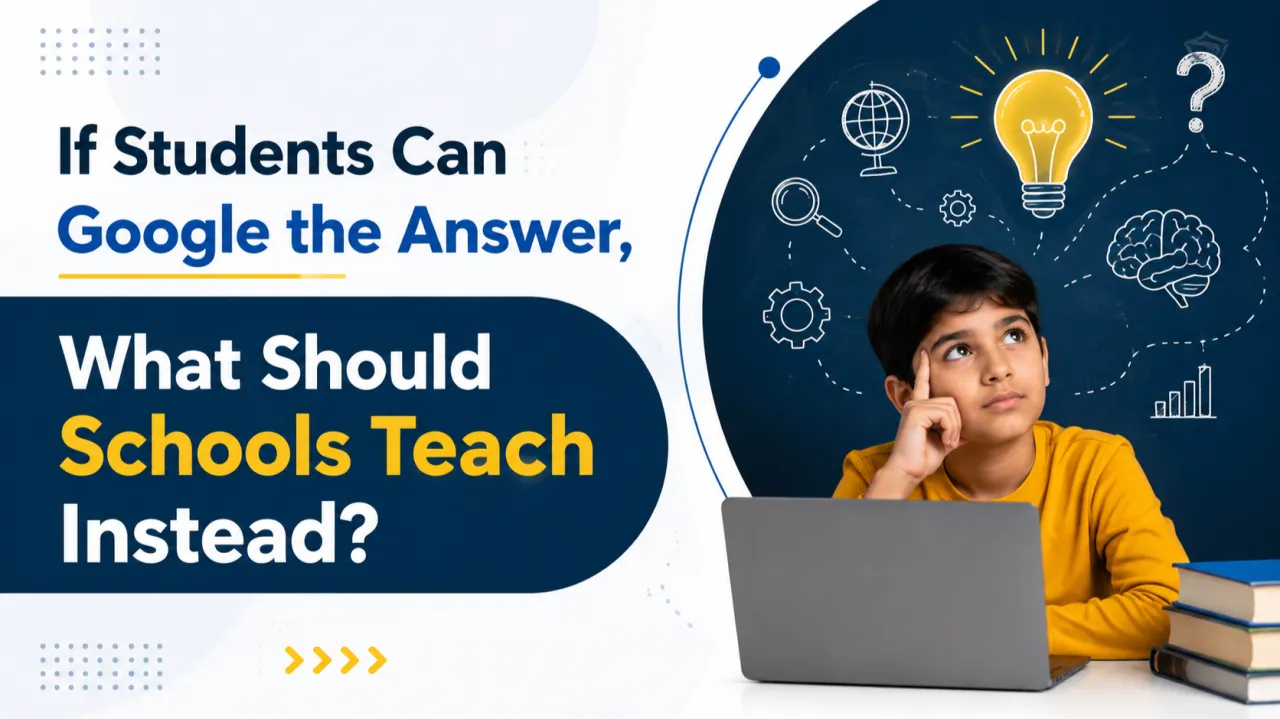
If Your Students Can Google the Answer, Why Are You Still Teaching It?

Ask any student a factual question today and watch what happens. They don’t raise their hand. They reach for their phone.Within seconds, they can search it, ask an AI assistant, watch a YouTube explainer, or pull up a step-by-step solution. The answer was never more than ten seconds away.
So here’s the uncomfortable question every school leader, teacher, and parent needs to sit with: if the answer is always available, what exactly are we teaching?
The honest answer isn’t “less education.” It’s a different kind of education altogether.
𝗧𝗵𝗲 𝗔𝗻𝘀𝘄𝗲𝗿 𝗪𝗮𝘀 𝗡𝗲𝘃𝗲𝗿 𝘁𝗵𝗲 𝗣𝗼𝗶𝗻𝘁
For generations, classrooms have been optimized for information transfer — facts, formulas, dates, definitions. That made sense when information was scarce and access to a good teacher or a good textbook was the bottleneck.
That bottleneck is gone.
What’s scarce now isn’t information. It’s the ability to question it, evaluate it, and do something useful with it.
Take a simple factual question: “What causes water pollution?” Any search engine answers that in half a second.
Now change the question: “How can we reduce water pollution in our neighborhood?”
There’s no Google answer for that. Students have to investigate, gather evidence, weigh trade-offs, work with others, and test ideas that might fail. That gap between a fact and a real problem is exactly where learning has to move.
𝗧𝗵𝗲 𝗤𝘂𝗲𝘀𝘁𝗶𝗼𝗻 𝗠𝗮𝘁𝘁𝗲𝗿𝘀 𝗠𝗼𝗿𝗲 𝗧𝗵𝗮𝗻 𝘁𝗵𝗲 𝗔𝗻𝘀𝘄𝗲𝗿
In a world of instant answers, the quality of the question is the actual skill.
Instead of training students to answer well, we should be training them to ask well:
→ Why does this happen? → What evidence actually supports this? → What happens if we change one variable? → Who is affected by this, and how? → What are we assuming without realizing it?
Curiosity gets treated like a personality trait some kids happen to have. It isn’t. It’s trainable — and it’s one of the highest-leverage things a classroom can build.
𝗖𝗿𝗶𝘁𝗶𝗰𝗮𝗹 𝗧𝗵𝗶𝗻𝗸𝗶𝗻𝗴 𝗜𝘀𝗻’𝘁 𝗢𝗽𝘁𝗶𝗼𝗻𝗮𝗹 𝗔𝗻𝘆𝗺𝗼𝗿𝗲
The internet doesn’t hand students clean information. It hands them knowledge, opinion, misinformation, advertising, and AI-generated content, all tangled together with no labels.
Finding information was the hard part in 2005. Knowing what to trust is the hard part in 2026.
The shift every classroom needs to make is simple to say and hard to do:
Stop asking “find the answer.” Start asking “find the evidence, evaluate it, and defend your reasoning.”
𝗦𝘁𝗼𝗽 𝗔𝘀𝘀𝗶𝗴𝗻𝗶𝗻𝗴 𝗪𝗼𝗿𝗸𝘀𝗵𝗲𝗲𝘁𝘀. 𝗦𝘁𝗮𝗿𝘁 𝗔𝘀𝘀𝗶𝗴𝗻𝗶𝗻𝗴 𝗣𝗿𝗼𝗯𝗹𝗲𝗺𝘀.
Real-world problems don’t show up formatted like a textbook exercise. They have multiple possible solutions, some of which will fail, and new information that keeps changing the picture halfway through.
This is exactly why hands-on, project-based learning — robotics being one of the clearest examples matters so much right now.
Give a student an open-ended challenge like “design a system that detects an obstacle” and something different happens. They have to think, build, test, fail, debug, and try again.
Failure isn’t a detour from learning. It is the learning.
𝗙𝗿𝗼𝗺 𝗖𝗼𝗻𝘀𝘂𝗺𝗲𝗿𝘀 𝘁𝗼 𝗖𝗿𝗲𝗮𝘁𝗼𝗿𝘀
Technology has made consuming information almost effortless. Students can watch, search, generate, and summarize without breaking a sweat.
Education’s job is to push one step further and ask: what can students build with what they know?
Not just learn about robotics — build a robot. Not just read about smart cities — design one. Not just learn about AI — understand how it actually works and build something responsible for it.
That shift, from consumer to creator, is where a classroom stops feeling like a lecture hall and starts feeling like a lab.
𝗖𝗼𝗺𝗽𝘂𝘁𝗮𝘁𝗶𝗼𝗻𝗮𝗹 𝗧𝗵𝗶𝗻𝗸𝗶𝗻𝗴 𝗜𝘀 𝗕𝗶𝗴𝗴𝗲𝗿 𝗧𝗵𝗮𝗻 𝗖𝗼𝗱𝗶𝗻𝗴
Computational thinking gets mistaken for “learning to code.” It’s actually a way of approaching any complex problem:
→ Break a big problem into smaller pieces → Spot the patterns and connections → Focus on what actually matters and ignore the noise → Build a logical sequence to solve it → Test, debug, improve, repeat
None of that is exclusive to computer science. It shows up in math, science, business, design, and honestly, most decisions adults make every day.
𝗔𝗜 𝗦𝗵𝗼𝘂𝗹𝗱𝗻’𝘁 𝗗𝗼 𝘁𝗵𝗲 𝗧𝗵𝗶𝗻𝗸𝗶𝗻𝗴 𝗙𝗼𝗿 𝗧𝗵𝗲𝗺
Generative AI raises the stakes on all of this. A student can now ask AI to write an essay, solve an equation, or explain a concept in seconds. Banning the tool isn’t a strategy — it’s a delay tactic.
What students actually need is to learn how to use AI well:
→ Write prompts that get useful, specific results → Check AI-generated information instead of trusting it → Recognize errors and hallucinations when they appear → Compare AI answers against reliable sources → Refine and personalize AI output rather than copy-pasting it → Understand what responsible, ethical AI use actually looks like
The goal was never to make students compete with AI. It’s to teach them to think alongside it — without quietly handing over the thinking.
𝗧𝗵𝗲 𝗖𝗹𝗮𝘀𝘀𝗿𝗼𝗼𝗺 𝗼𝗳 𝘁𝗵𝗲 𝗙𝘂𝘁𝘂𝗿𝗲 𝗟𝗼𝗼𝗸𝘀 𝗟𝗶𝗸𝗲 𝗮 𝗟𝗮𝗯, 𝗡𝗼𝘁 𝗮 𝗟𝗲𝗰𝘁𝘂𝗿𝗲 𝗛𝗮𝗹𝗹
The biggest shift underneath all of this is moving from passive learning to active learning.
Instead of starting every lesson with “today I will tell you what you need to know,” the better opening line is: “here’s a problem — what can you figure out?”
From there, students investigate, collaborate, experiment, build, fail, revise, and present. And somewhere in that process, they discover something most exam-driven systems never teach them: learning isn’t about remembering information. It’s about knowing what to do with it.
This is exactly why approaches like STEAM, robotics, coding, and project-based learning aren’t “extras” bolted onto a curriculum. They’re the mechanism that turns knowledge into action.
𝗦𝗼 𝗪𝗵𝗮𝘁 𝗦𝗵𝗼𝘂𝗹𝗱 𝗦𝗰𝗵𝗼𝗼𝗹𝘀 𝗔𝗰𝘁𝘂𝗮𝗹𝗹𝘆 𝗧𝗲𝗮𝗰𝗵?
Not fewer facts. Not fewer subjects. Not less rigor.
Schools should double down on the skills that get more valuable, not less, as information gets more accessible:
Curiosity — to ask sharper questions; Critical thinking — to evaluate what’s true; Problem-solving — to handle the unfamiliar; Creativity — to imagine what doesn’t exist yet; Computational thinking — to manage complexity; Collaboration — to build with others; Communication — to explain ideas clearly; AI literacy — to use technology responsibly; Hands-on skills — to turn ideas into something real
Google can hand a student an answer. AI can hand them ten. Neither can ask, on their behalf:
“Is this even the right question?” “Can I trust this answer?” “What can I actually do with it?”
And the one that matters most:
“What can I create that doesn’t exist yet?”
That’s the real work ahead for education — not knowing everything, but knowing how to think, how to learn, and how to create.What’s one thing you wish your own school had taught you instead of another fact you’ve since forgotten? Curious to hear how educators and parents in my network are thinking about this shift.