☎ 1800 202 2912 | +91 9717773968 | info@inventanteducation.com

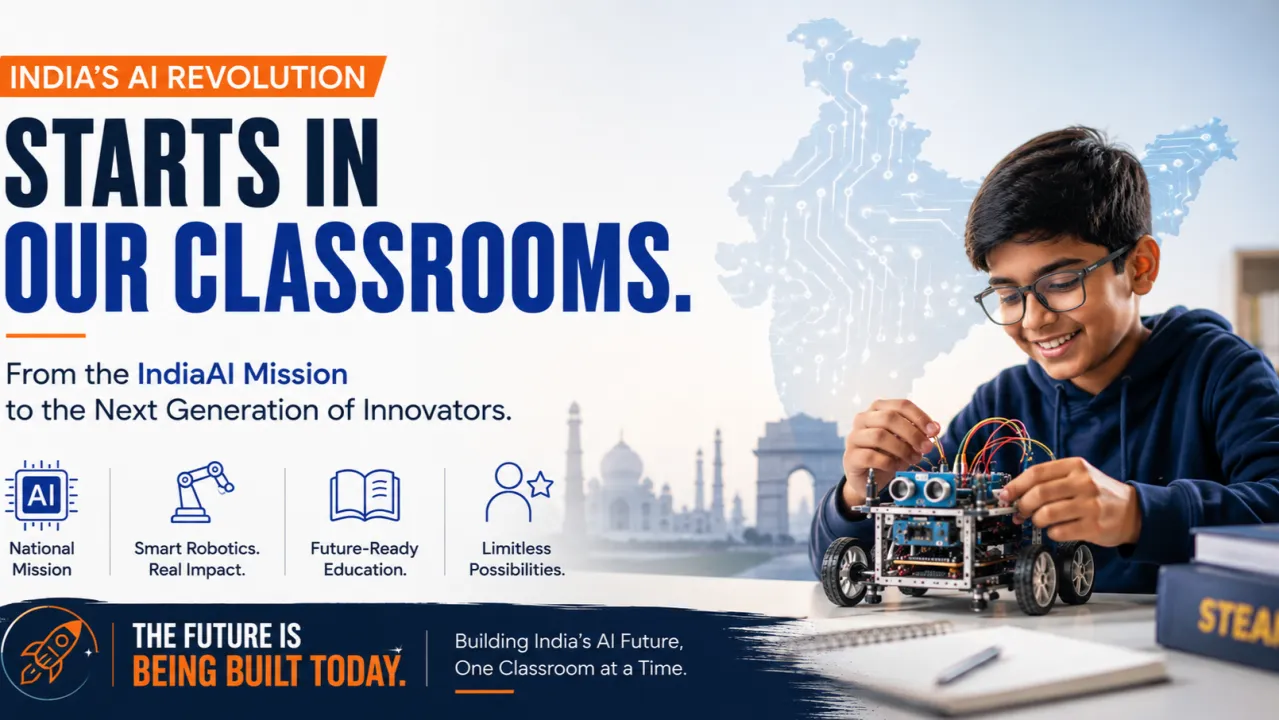
India’s AI and Robotics Mission: Why the Classroom Is the Real Launchpad

How the IndiaAI Mission’s national ambitions, NEP 2020, and the future of Indian STEM education connect and where Inventant Education fits in
A Nation Betting Big on AI
Walk through Bharat Mandapam in New Delhi this February, and you’d have seen something telling: the India AI Impact Summit 2026 wasn’t just slideshows and policy panels. It was humanoids, quadrupeds, and mobile robots sharing floor space with government officials and global tech leaders. Robotics, it turns out, is how AI stops being an abstraction and starts looking like the future.
This is no accident. It’s the visible edge of a much bigger, coordinated push for the IndiaAI Mission and it says a lot about where the country is headed, and why the next generation needs to be ready for it.
What the IndiaAI Mission Actually Is
Run under the Digital India Corporation (Ministry of Electronics and Information Technology), the IndiaAI Mission isn’t a single project; it’s closer to a national operating system for AI development. Its job is to find AI solutions that are actually ready to deploy and can solve real governance and public-service problems, not just look good in a lab demo.
A few things anchor the mission:
- Compute at scale. The plan is to bring 10,000 GPUs online through the mission, on top of the 38,000 already available across the country — offered at a subsidised rate to make serious AI development affordable for startups and researchers, not just big tech.
- Sector-first thinking. The mission’s priority areas read like a list of India’s biggest opportunities: AI-based diagnostics and telemedicine, crop monitoring and smart farming, personalised learning, smarter public services, and disaster prediction.
- Application over theory. Through the IndiaAI Application Development Initiative, the mission works directly with ministries Ayush, MSME, and others — to get AI out of research papers and into daily governance.
- A pipeline for builders. Programs like the BuildAI Tech PitchSprint (run with IIT Gandhinagar) are explicitly inviting robotics solutions alongside healthcare, agriculture, and manufacturing, a sign that robotics isn’t a side note to India’s AI story, it’s a core chapter.
Robotics Is Where the Ambition Becomes Visible
At the Impact Summit, homegrown robotics companies made the abstraction tangible. Addverb Technologies showed off Elixis, a general-purpose humanoid built for industrial environments, using LiDAR and depth sensing to navigate its surroundings. Ottonomy’s Ottobots demonstrated autonomous last-mile delivery. TCS brought Puchu, a conversational robotic assistant designed for offices and customer-facing roles.
None of this happened by accident. It’s the output of years of investment in robotics education, talent pipelines, and startup ecosystems, the kind of groundwork that has to start long before a robot walks onto an expo floor.
And that’s exactly where it gets interesting for education.
The Missing Link: Where Does This Talent Come From?
A national AI and robotics mission is only as strong as the pipeline of people who can build, maintain, and innovate within it. GPUs and policy frameworks don’t create engineers — classrooms do. If India wants its next Elixis or Ottobot to come from a Tier-2 city rather than a handful of metros, robotics literacy needs to start at the school level, not at the undergraduate level.
The numbers suggest the pressure is already building. STEM-related job postings in India grew by 44% between 2016 and 2019, and India’s robotics market itself continues to expand at roughly 13–15% annually at a pace that assumes a steady supply of engineers who understand automation from the ground up, not just in theory. That supply has to be seeded years before a student ever applies for an engineering seat.
This is precisely the gap Inventant Education Goyal Brothers Prakashan’s STEM and robotics-focused K-12 arm is built to close.
The NEP 2020 Blueprint — and Who’s Actually Building to It
It’s easy to treat NEP 2020 as a policy document. On the ground, it’s increasingly an infrastructure rollout. Coding is now expected from Class 6 onward, experiential and hands-on learning has been positioned as the default pedagogy rather than the exception, and states are moving fast to match that mandate with real classroom hardware. Gujarat’s technology-enabled education ecosystem now reaches over 1.15 crore students across 54,000 schools, Rajasthan has run more than 45 lakh AI-enabled student assessments, Uttar Pradesh has expanded the PM SHRI scheme to 1,713 schools, and Chhattisgarh has introduced robotics and AI education across 800 government schools.
That’s not a pilot program anymore, that’s a rewiring of how tens of millions of Indian students will encounter technology for the first time. And it creates an unusually specific opportunity: whoever builds the actual tools, kits, and curriculum that let a Class 6 classroom meet NEP 2020’s coding and robotics expectations gets to shape what “AI-ready” means for an entire generation.
Inventant Education: Building the Base of the Pyramid
While national missions focus on compute, funding, and enterprise deployment, Inventant Education is solving a quieter but equally critical problem: making sure school students actually understand how AI and robotics work, hands-on, years before they’d ever encounter it in a policy document or a summit floor.
The recently launched Grade 6 Smart City Robotics Kit is a good example of this philosophy in action. It’s a hands-on breadboard electronics kit, aligned with NEP 2020 and CBSE frameworks, designed to let students build and understand real robotic systems not just read about them. Students working through concepts like sensors, circuits, and smart-city automation at age eleven are getting a head start that mirrors, in miniature, exactly what India’s AI mission is trying to build at scale: people who can turn AI theory into physical, working systems.
That alignment matters for a very practical reason. NEP 2020 sets the direction coding from Class 6, experiential learning as the norm, early exposure to emerging technology but it deliberately doesn’t prescribe a single blueprint for how schools get there. That gap between policy intent and classroom execution is exactly where curriculum-grade tools have to step in. Inventant Education’s kits are built to sit inside that gap: NEP-aligned, CBSE-compliant, and designed for a teacher who needs something that works on day one, not a lab that needs six months of setup.
The IndiaAI Mission talks about personalised learning and skill development as a national priority. Inventant Education is one of the few players actually building the tools that make that priority real in a classroom at the exact age when curiosity about how things work is still the strongest lever a teacher has.
While the IndiaAI Mission is building India’s AI ecosystem, Inventant Education is helping schools build the human capital that will power it. Through robotics labs, AI learning modules, structured STEM curricula, and teacher enablement, it translates national AI ambitions into meaningful classroom experiences turning a policy vision into something a student can actually pick up, wire, and watch come to life.
Why This Connection Matters
It’s tempting to see national AI missions and school robotics kits as operating in completely different worlds one is government policy and enterprise robotics, the other is classroom curriculum. But they’re two ends of the same pipeline:
- The IndiaAI Mission is building the infrastructure, funding, and application layer for AI to scale across sectors.
- Companies like Addverb, Ottonomy, and TCS are proving what’s possible when that infrastructure meets real engineering talent.
- Inventant Education is making sure that talent has somewhere to start a genuine, hands-on introduction to robotics and AI concepts before students ever set foot in an engineering college.
A national mission with 10,000 GPUs and ambitious sector goals still needs a steady supply of students who grew up building circuits, not just consuming content. That’s the bet Inventant Education is making, and it’s a bet that lines up remarkably well with where India’s AI ambitions are heading.
The Takeaway: Two Altitudes, One Trajectory
India’s AI and robotics story in 2026 is being told at two very different altitudes one at Bharat Mandapam with humanoids and GPU clusters, and one in a Grade 6 classroom with a breadboard and a smart-city robotics kit. Both matter. But it’s the second one that determines whether the first one has a future workforce to sustain it.
Ten years from now, the engineers building India’s next generation of industrial humanoids and autonomous systems will not remember the GPU count or the policy framework that made their careers possible. They’ll remember the first circuit they wired, the first sensor they got to respond to light, the first time a robot they built actually did what they told it to. That memory is being created right now, in classrooms most national conversations never mention.
India doesn’t just need a mission for AI and robotics at the national level — it needs one at the desk level, in every school, for every eleven-year-old who might otherwise never get the chance to find out they’re good at this. That’s the mission Inventant Education has quietly signed up for. And if the last few years are any indication, it’s a mission that scales exactly as fast as India’s classrooms are ready to let it.
Inventant Education is part of the Goyal Brothers Prakashan group, developing STEM and robotics learning tools for K-12 classrooms across India, aligned with NEP 2020 and CBSE curriculum.