☎ 1800 202 2912 | +91 9717773968 | info@inventanteducation.com

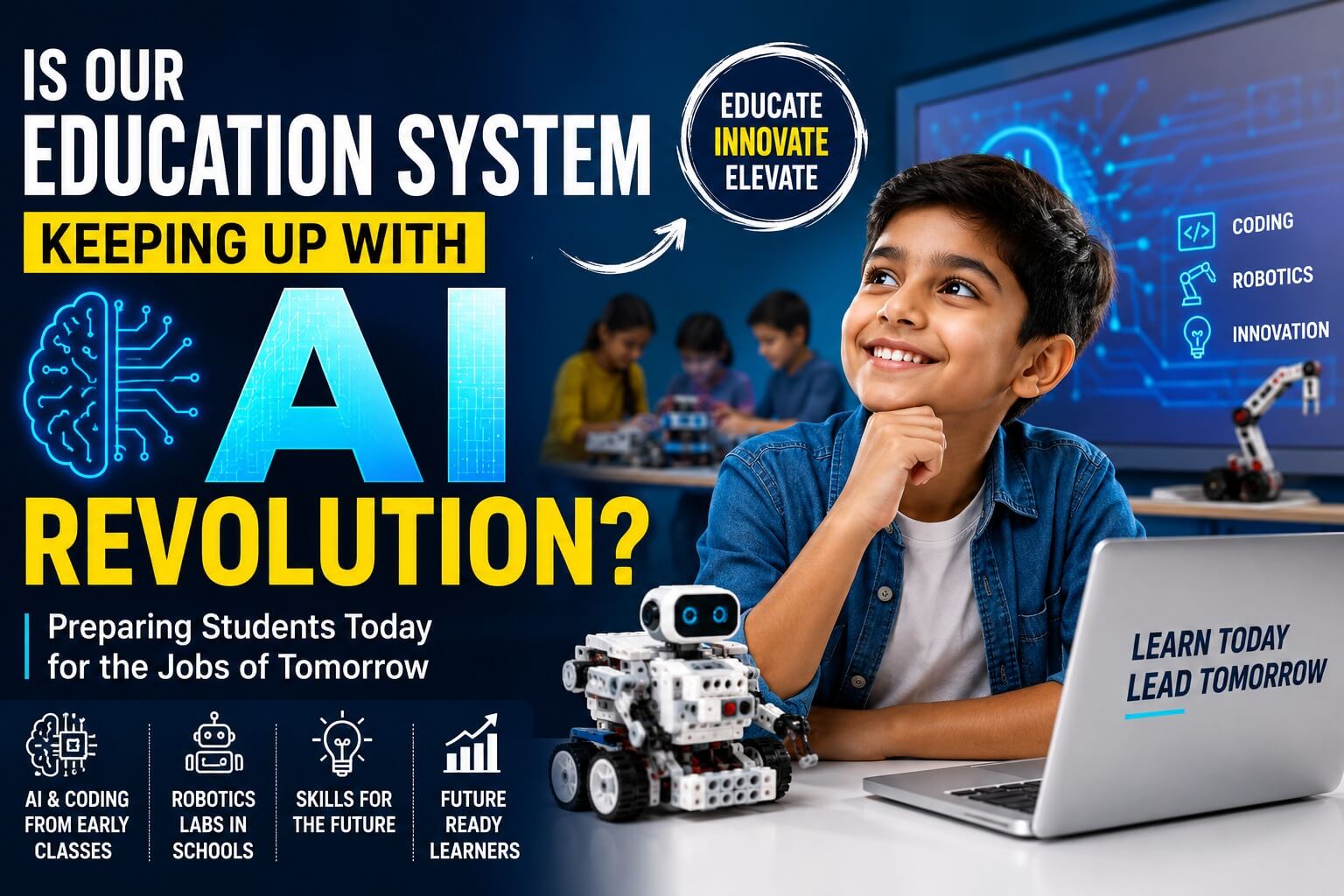
Is India’s Education System Ready for the AI Revolution?

Artificial Intelligence is transforming the world faster than ever before. From automation and robotics to AI-powered tools and intelligent software, technology is reshaping industries, businesses, and careers at an unprecedented speed. Every day, new AI innovations are changing how people work, learn, communicate, and solve problems.
But amid this rapid technological growth, one critical question stands out:
Is our education system evolving at the same pace as Artificial Intelligence?
This is no longer just a discussion for technology experts. It is a concern for schools, educators, parents, policymakers, and students across the globe.
As AI continues to redefine the future of jobs, industries, and skills, the role of education has become more important than ever. Schools and educational institutions must now prepare students not only for examinations but also for a future driven by Artificial Intelligence, robotics, coding, automation, and digital technologies.
The future belongs to students who are technologically skilled, innovative, adaptable, and capable of working alongside AI systems. This is why AI education in schools is no longer optional, it is becoming essential.
Why AI Education Is Important for Students
Artificial Intelligence is already influencing almost every sector:
- Healthcare
- Agriculture
- Finance
- Manufacturing
- Media
- Transportation
- Education
- Security
- Retail
- Aviation
As industries adopt AI and automation, many traditional jobs are changing. At the same time, new career opportunities are emerging in areas like:
- Artificial Intelligence
- Robotics
- Machine Learning
- Data Science
- Drone Technology
- Cybersecurity
- Automation Engineering
- Software Development
- Smart Manufacturing
This rapid transformation has created both excitement and fear. Many professionals worry that AI may replace jobs in the future. However, the bigger challenge is not AI itself; the challenge is whether students are being prepared with the right future-ready skills.
This is where modern education systems play a crucial role.
To survive and grow in the AI era, students need:
- Digital literacy
- Coding knowledge
- Computational thinking
- Problem-solving abilities
- Creativity and innovation
- Practical technology exposure
- Robotics understanding
- Adaptability to new technologies
Without these skills, students may struggle in future industries that are increasingly driven by technology and automation.
How Artificial Intelligence Is Changing the Education System
The traditional education model focused heavily on memorisation, theory-based learning, and examination performance. But the future demands a completely different approach.
Today’s students need practical learning experiences that prepare them for real-world technological challenges.
Modern education must focus on:
- Skill-based learning
- AI and coding education
- Robotics and STEM learning
- Project-based learning
- Innovation and experimentation
- Critical thinking
- Hands-on technology exposure
Educational institutions must now move beyond conventional classroom teaching and create learning environments where students can build, create, experiment, and innovate using technology.
The integration of Artificial Intelligence in education is no longer a luxury; it is a necessity.
Is India’s Education System Ready for AI and Future Technologies?
India’s education ecosystem is gradually evolving. The government, policymakers, and educational organisations are introducing:
- Updated education policies
- Skill-development initiatives
- Digital learning programs
- AI-focused curriculum changes
- Coding and STEM education programs
The National Education Policy (NEP) has also encouraged more practical and skill-oriented learning approaches.
However, policy changes alone are not enough.
The real transformation must happen inside schools and classrooms.
Schools must upgrade:
- Infrastructure
- Teaching methodologies
- Technology integration
- Practical learning systems
- Teacher training
- Innovation ecosystems
If schools fail to adapt to the changing technological landscape, students may struggle to compete in future industries.
The speed of educational transformation must match the speed of AI advancement.
Why Coding and Robotics Should Be Introduced from Primary Classes
One of the biggest shifts happening globally is the introduction of coding, robotics, and AI education at an early age.
Children today grow up surrounded by technology. They are naturally curious, adaptive, and quick learners. Introducing future technologies from primary classes helps students develop:
- Logical thinking
- Creativity
- Analytical skills
- Technical confidence
- Innovation mindset
- Problem-solving abilities
Learning coding and robotics is not just about becoming programmers or engineers. It helps students understand how technology works and teaches them how to think systematically.
Students who learn coding and AI early become creators of technology instead of just consumers of technology.
Just as mathematics and science became essential subjects over time, Artificial Intelligence and digital literacy are becoming equally important for future generations.
The Growing Importance of Robotics Labs in Schools
Robotics labs are becoming one of the most important additions to modern schools.
A robotics lab gives students hands-on exposure to:
- Robotics systems
- Automation technology
- Sensors and electronics
- Coding applications
- Engineering concepts
- Real-world problem solving
These labs encourage experiential learning, where students learn by building and experimenting.
Robotics education also improves:
- Teamwork
- Innovation
- Creativity
- Technical understanding
- Communication skills
Schools that invest in robotics and AI labs are preparing students for the industries of tomorrow.
How Inventant Education Is Supporting Future-Ready Learning
As the demand for AI education and coding in schools increases, educational organisations have an important responsibility to bridge the gap between traditional education and future technologies.
Inventant Education is actively working in this direction by helping schools adopt future-focused education systems designed for the modern technological era.
The organisation is providing world-class and internationally aligned textbooks for:
- Artificial Intelligence
- Computer Education
- Coding
- Technology-based learning
These programs are designed for students starting from Class 3 onwards, helping children develop digital and computational skills from an early stage.
In addition, Inventant Education also supports schools in establishing robotics labs and innovation centres where students can gain practical exposure to robotics, automation, and emerging technologies.
This combination of theoretical learning and practical implementation is essential for creating future-ready students.
Future Jobs Will Require Future Skills
One of the biggest realities of the AI revolution is that many future jobs do not yet exist.
Students currently studying in schools may eventually work in fields such as:
- AI Engineering
- Drone Operations
- Robotics Automation
- Machine Learning
- Smart Agriculture
- Human-AI Collaboration
- Virtual Reality
- Data Analytics
- Intelligent Systems Design
Traditional education models were not originally designed for such rapidly changing industries.
This is why schools must prepare students not only for current careers but also for emerging future opportunities.
The education system must evolve from:
“Learning for exams”
to
“Learning for innovation and future careers.”
The Future of Education in the Age of AI
The future of education will depend on how effectively schools integrate technology, innovation, and practical learning into everyday education.
Future-ready schools will focus on:
- AI literacy
- Coding education
- Robotics training
- STEM learning
- Digital creativity
- Innovation labs
- Practical technology applications
Students who adapt to technology and continuously learn new skills will have a significant advantage in the future workforce.
The AI revolution is not slowing down. Technology will continue evolving rapidly, and education systems must evolve alongside it.
Because in the future, success will not belong only to students who score high marks.
It will belong to students who can:
- Think critically
- Solve problems
- Adapt quickly
- Innovate confidently
- Work alongside technology
And that preparation must begin from school itself.
Conclusion
Artificial Intelligence is reshaping the future of industries, careers, and human potential. The biggest responsibility now lies with educational institutions to ensure students are ready for this transformation.
Schools must move beyond traditional learning models and embrace:
- AI education
- Coding
- Robotics
- Skill-based learning
- Practical technology exposure
Organizations like Inventant Education are contributing significantly by helping schools modernize education through AI, coding, computer education, and robotics infrastructure.
The future belongs to students who are prepared for change.
And the future of education depends on how quickly we act today.